Robotics in Transportation & Airports
The modern transit ecosystem is undergoing a radical transformation driven by autonomous efficiency. From streamlining baggage logistics to ensuring passenger safety through continuous surveillance, robotics is redefining the infrastructure of global mobility.
Why Robotics Matters Here
Operational Bottlenecks
Airports and transit hubs face massive congestion peaks. Robotics automate flow management, reducing passenger wait times by up to 30% during rush hours.
Labor Shortages
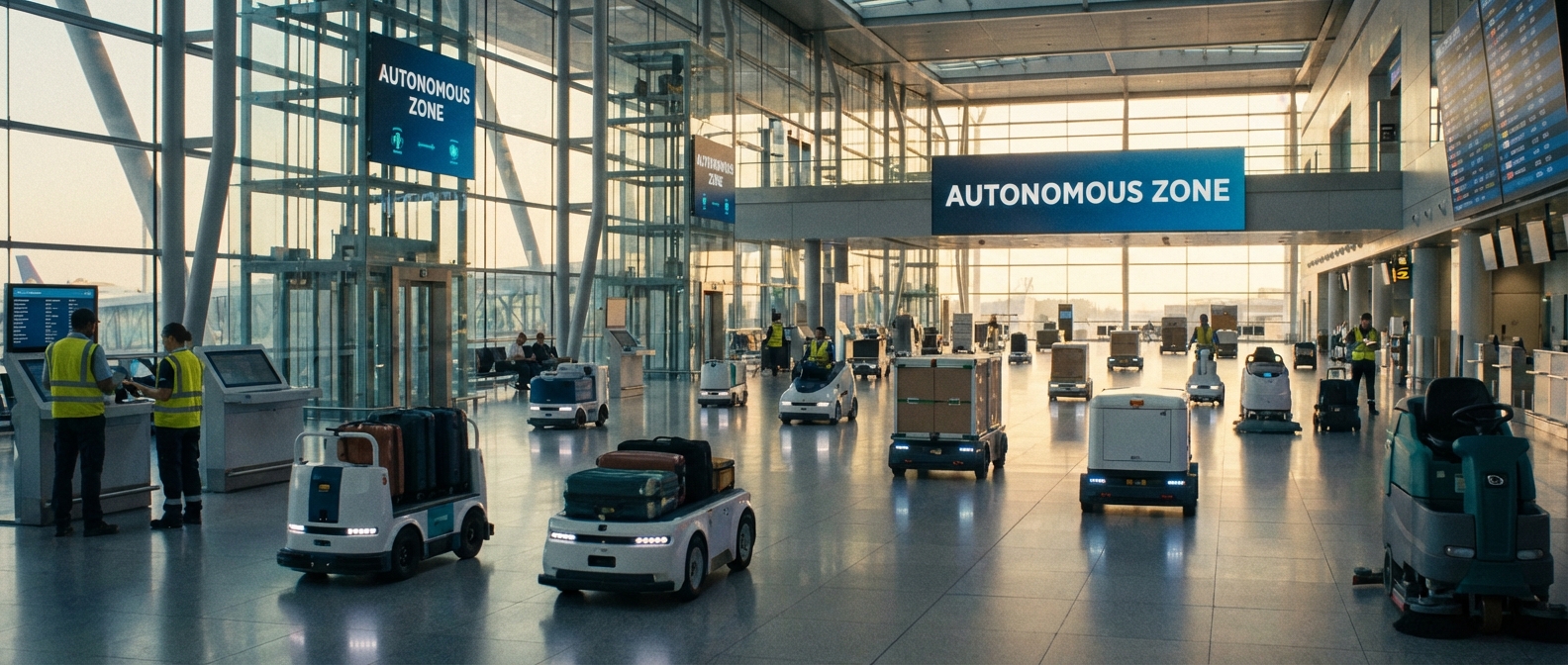
Ground handling and maintenance crews are understaffed. Autonomous ground vehicles (AGVs) fill the gap, handling baggage and cargo 24/7 without fatigue.
Enhanced Security
Static cameras leave blind spots. Mobile security robots patrol perimeters and terminals, utilizing AI to detect anomalies and unclaimed luggage instantly.
Energy Efficiency
Legacy support vehicles are fuel-inefficient. Electric autonomous fleets optimize routes and reduce carbon emissions, aligning with green infrastructure goals.
Infrastructure Maintenance
Runway and rail inspections are costly and disruptive. Drones and crawlers perform precision inspections during short operational windows, preventing failures.
Passenger Experience
Navigating complex terminals is stressful. Service robots provide multi-lingual guidance and assistance, improving satisfaction scores.
Applications in Transportation & Airports
Airport Baggage Handling
Learn how airport baggage handling transforms transportation & airports by automating sorting and transport logistics.
Explore Application →Security Patrol
Learn how security patrol transforms transportation & airports through autonomous surveillance and threat detection.
Explore Application →Parking Lot Management
Learn how parking lot management transforms transportation & airports by optimizing space utilization and valet services.
Explore Application →How to Deploy
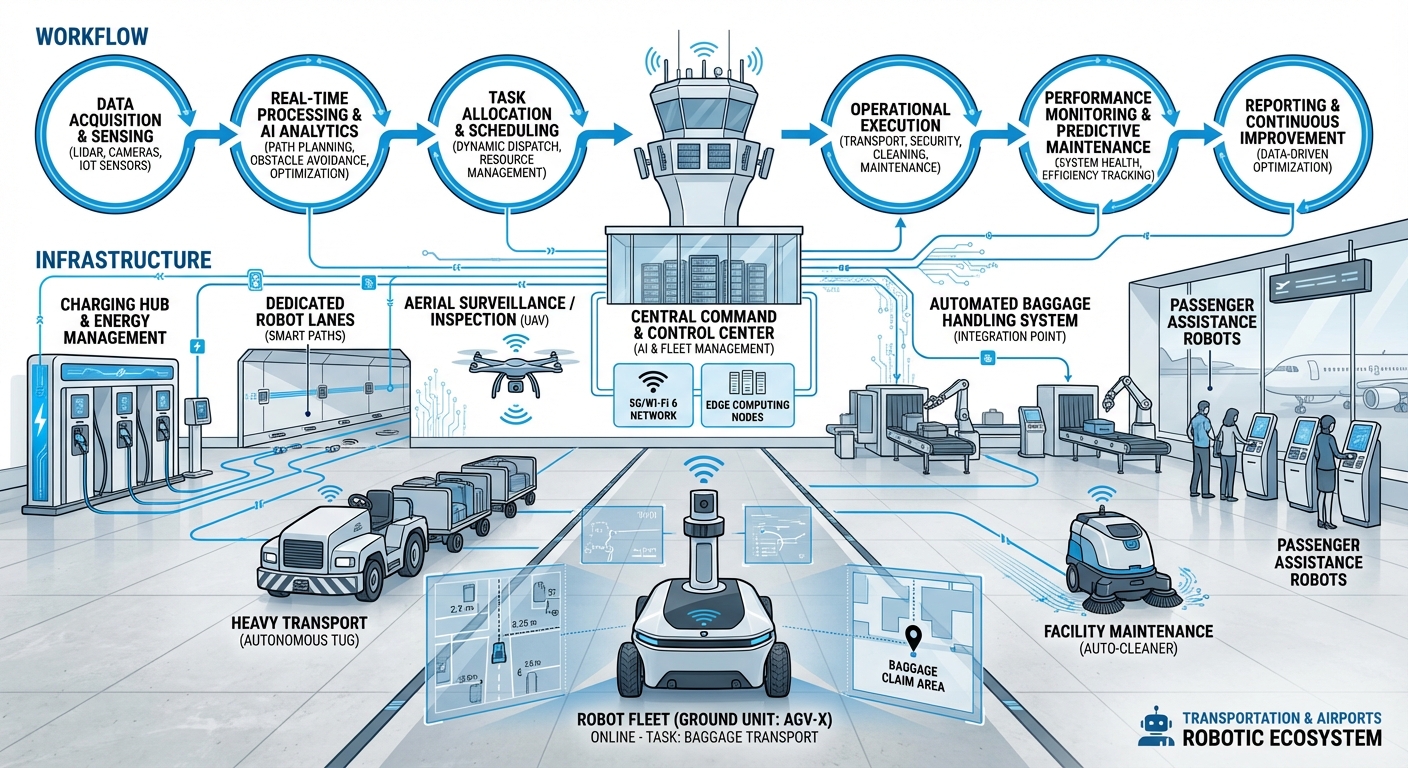
Implementing robotics in high-security, high-traffic environments like airports requires a phased strategic approach. We begin with a digital twin simulation of your facility to identify bottlenecks without disrupting current operations.
Phase two involves the integration of autonomous units into the "airside" or "landside" infrastructure. This includes setting up charging docks, establishing localized 5G networks for low-latency communication, and integrating robotic APIs with existing Flight Information Display Systems (FIDS).
Finally, we scale the fleet based on real-time data analytics. Our centralized fleet management software allows for the coordination of heterogeneous robots—managing baggage tugs, cleaning bots, and security drones from a single dashboard.
Success Stories
Reducing Baggage Mishandling by 40%
Challenge: High rates of lost luggage during transfers between terminals.
Solution: Deployed a fleet of 50 autonomous baggage carts synchronized with flight data.
Sanitation at Scale
Challenge: Maintaining hygiene across 200+ stations during a health crisis.
Solution: Integration of UV-C disinfection robots operating during off-peak hours.
Automating Container Logistics
Challenge: Dangerous working conditions and slow throughput in container yards.
Solution: Implementation of Autonomous Straddle Carriers connected to TOS.
Predictive Track Maintenance
Challenge: Manual inspections were slow and prone to human error.
Solution: Drones and rail-crawlers equipped with LiDAR and thermal imaging.
Industry-Specific Questions
How do robots navigate crowded airport terminals safely?
Robots utilize a combination of LiDAR, 3D cameras, and ultrasonic sensors to create dynamic maps. They use SLAM (Simultaneous Localization and Mapping) technology to detect and avoid moving obstacles—such as rushing passengers or luggage carts—in real-time, stopping instantly if a path is blocked.
Are these systems compliant with TSA and FAA regulations?
Yes. All robotics deployed in secure areas (airside) are designed to meet strict TSA security protocols and FAA safety standards. They include tamper-proof hardware, encrypted communication channels, and remote override capabilities for security personnel.
Can baggage robots handle oversized or fragile items?
Autonomous baggage handling systems (ABHS) are modular. While standard trays handle 90% of luggage, specialized heavy-load bots are deployed for oversized items (skis, instruments) and fragile cargo, ensuring gentler handling than manual processes.
How does weather affect outdoor autonomous vehicles on the tarmac?
Modern industrial robots are IP65/IP67 rated for weather resistance. Their sensor suites (specifically radar and thermal) allow them to operate effectively in rain, snow, fog, and low-light conditions where human visibility is compromised.
Do these robots replace human jobs in transportation?
The primary goal is to alleviate labor shortages in high-turnover roles (like baggage lifting and cleaning) and move human workers to higher-value supervisory roles. This reduces workplace injuries and improves overall staff retention.
What is the battery life and charging time?
Most industrial transit robots run for 8-12 hours on a single charge. They utilize "opportunity charging," automatically docking during short operational lulls to top up batteries, ensuring 24/7 fleet availability without long downtime.
Can the robots integrate with legacy airport software?
Absolutely. Our middleware acts as a bridge between modern robotic fleets and legacy systems like AODB (Airport Operational Database) and BHS (Baggage Handling Systems), ensuring seamless data exchange.
How secure is the data collected by patrol robots?
Data security is paramount. Video feeds and sensor data are encrypted end-to-end. We offer on-premise server deployment options for high-security facilities to ensure sensitive data never leaves the local network.
What happens if a robot breaks down in a critical path?
Fleet management software constantly monitors health. If a fault is detected, the robot moves to a safe zone if possible. If immobilized, the system automatically reroutes traffic around it and dispatches a tow-bot or maintenance crew immediately.
Is custom branding available for service robots?
Yes. Passenger-facing robots can be fully wrapped in airport or airline branding. Their interfaces can also be customized to reflect the specific tone and voice of the transit authority.
Ready to transform Transportation & Airports?
Join the leading transit hubs worldwide that are increasing efficiency, safety, and passenger satisfaction through automation.
Explore Our Robots