Security Patrol
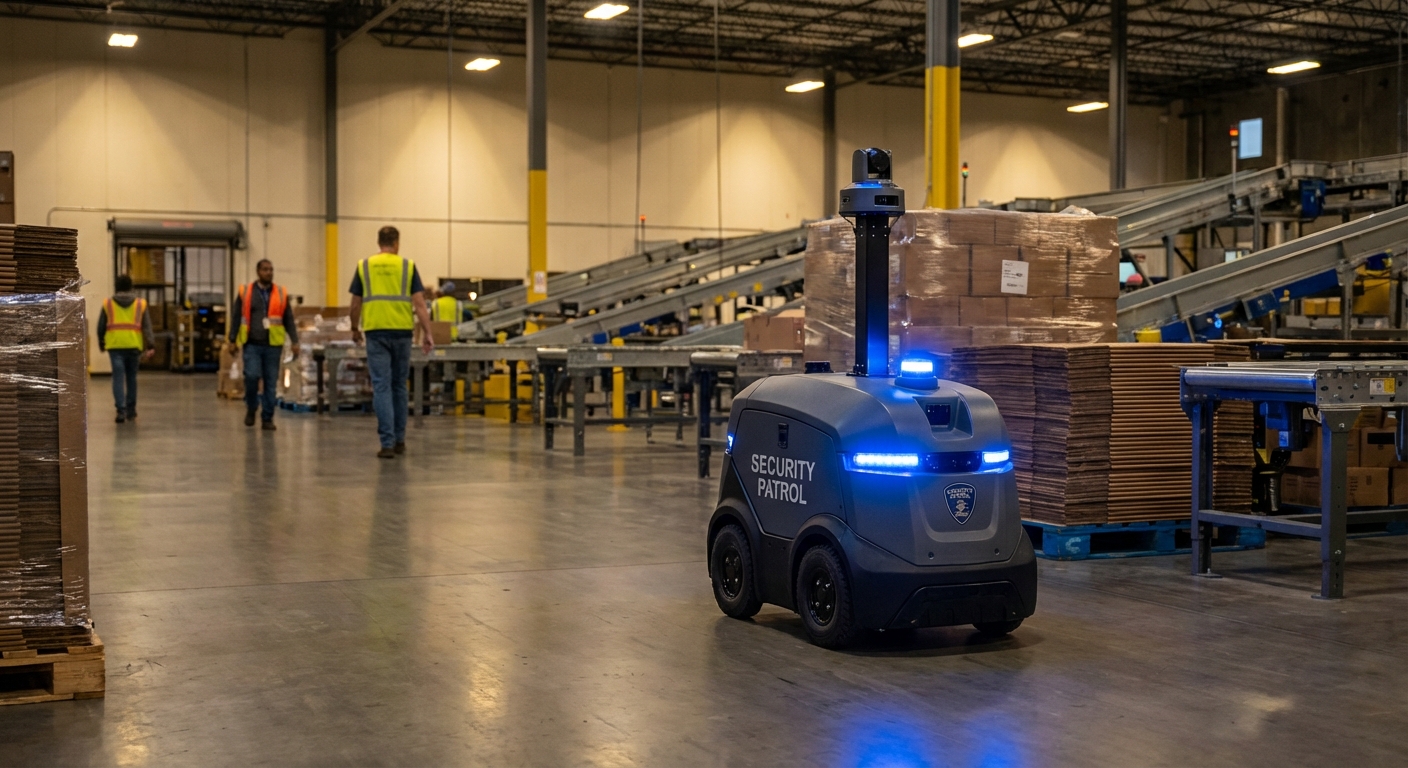
Elevate your facility's safety with autonomous mobile surveillance. The Security Patrol application ensures 24/7 monitoring, real-time threat detection, and comprehensive incident reporting without putting human personnel at risk.
Why Automate Security Patrol?
24/7 Continuous Operation
Robots don't suffer from fatigue. Maintain consistent, vigilant patrols during graveyard shifts, weekends, and holidays.
Cost Efficiency
Significantly reduce overhead by augmenting human teams. One operator can manage a fleet of robots remotely.
Enhanced Sensing
Equipped with thermal imaging and night vision, our robots detect intruders or heat anomalies that the human eye misses.
Reduced Risk
Keep humans out of harm's way. Send robots to investigate alarms, hazardous leaks, or potentially hostile intruders first.
Digital Trail
Every patrol is logged with time-stamped video and sensor data, providing irrefutable evidence for audits and insurance.
Instant Alerts
The system integrates with your VMS. Upon detecting an anomaly, alerts are instantly pushed to the central command.
Intelligent Workflow Integration
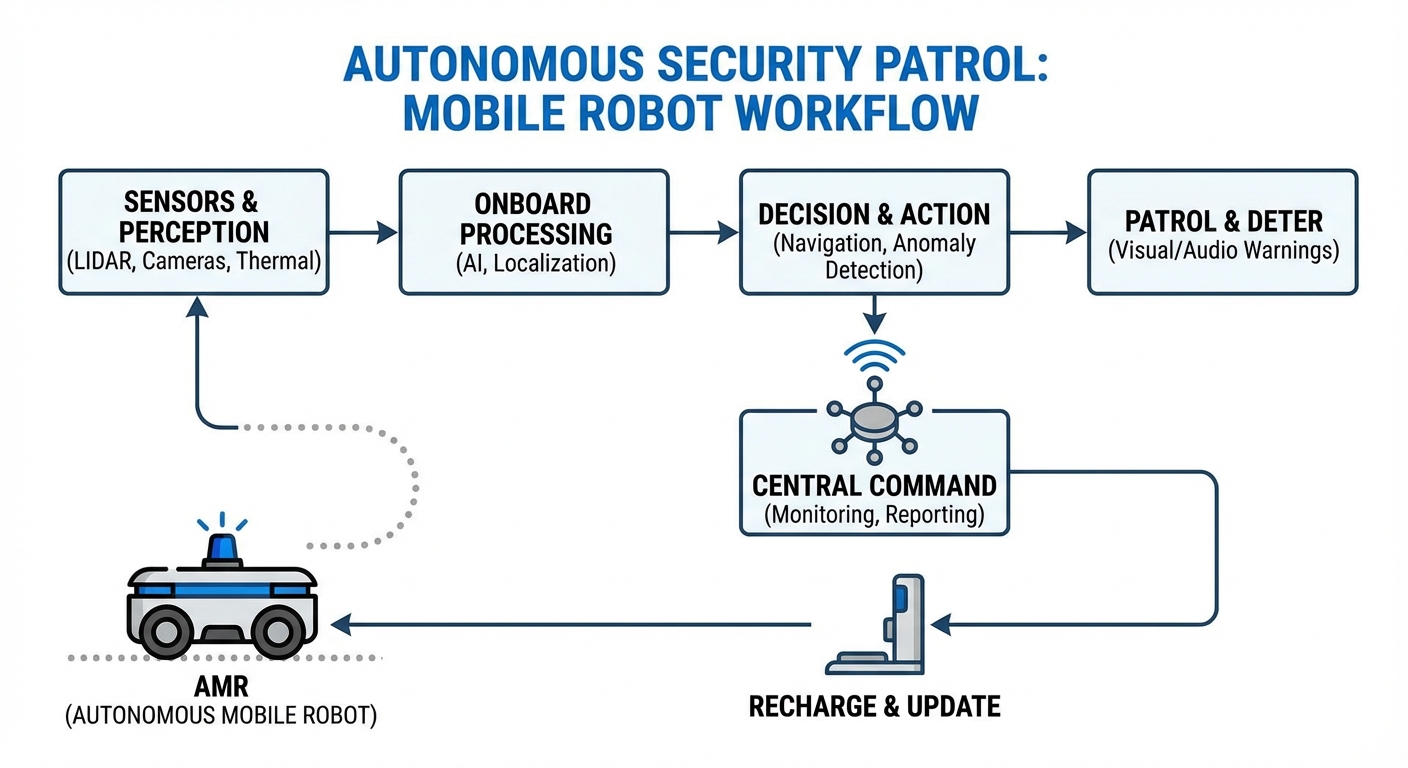
Our Security Patrol application transforms a standard mobile robot into an intelligent sentry. The process begins with SLAM mapping, creating a digital twin of your facility. Security managers then define specific waypoints and "No-Go" zones via our web interface.
During operation, the robot utilizes sensor fusion (LiDAR, RGB-D, and Thermal) to navigate dynamic environments. AI algorithms run locally on the edge, analyzing video feeds in real-time to identify people, open doors, or suspicious objects.
When a threshold is breached, the robot triggers a multi-stage response: audible warnings, strobe lights, and an immediate encrypted stream transmission to the human security team for verification and intervention.
Where It's Used
Warehousing & Logistics
Large footprint facilities with high-value inventory.
- Perimeter fence monitoring.
- After-hours inventory protection.
- Fire and smoke early detection.
Data Centers
High-security environments requiring strict access control.
- Server rack temperature monitoring (Thermal).
- Verification of secure door closures.
- Authorized personnel escorting.
Corporate Campuses
Open environments with mixed foot traffic.
- Parking lot surveillance and safety.
- Lobby and hallway patrols.
- Visible deterrence for unauthorized entry.
Critical Infrastructure
Power plants, water treatment, and chemical facilities.
- Inspection of hazardous areas.
- Gas leak detection (with added sensors).
- Gauge reading and visual inspection.
What You Need
| Component | Requirement |
|---|---|
| Robot Chassis | Differential drive or Ackermann steering mobile base capable of 1m/s speed. |
| Compute Unit | NVIDIA Jetson Xavier/Orin or Industrial PC (i7 equivalent) for edge AI processing. |
| Sensors | 2D/3D LiDAR (30m range), Depth Camera, IMU, Optional Thermal Camera. |
| Connectivity | WiFi 6 or Private 5G network covering the full patrol area. |
| Software Stack | Ubuntu 20.04/22.04, ROS 2 (Humble/Iron), Docker support. |
Frequently Asked Questions
How long does the battery last during continuous patrol?
Battery life depends on the specific robot chassis used, but typical runtimes range from 8 to 12 hours. The application includes autonomous docking logic, so the robot will automatically return to its charging station when battery levels dip below 20%.
What happens if the robot loses WiFi connection?
The robot is designed with edge-first architecture. It will continue its patrol route and local recording even without connectivity. Once connection is restored, it will sync data and buffered alerts to the central server. If the outage persists, it can be programmed to return to a known "safe home" location.
Can the robot operate in total darkness?
Yes. The navigation system relies on LiDAR, which uses laser light and functions perfectly in the dark. For surveillance, we recommend equipping the robot with thermal cameras or IR-illuminated RGB cameras to capture clear footage in low-light conditions.
Does the robot record audio?
Audio recording capabilities are available but disabled by default to comply with various privacy regulations (such as GDPR or local wiretapping laws). It can be enabled if your legal requirements permit.
Can the robot open doors or use elevators?
The robot typically cannot physically manipulate door handles. However, the system integrates with standard Access Control APIs. If you have automatic doors or smart elevators, the robot can wirelessly trigger them to open/arrive.
How secure is the data collected by the robot?
Security is our priority. All local data is encrypted at rest (AES-256). Video streams use TLS 1.3 encryption. We support on-premise deployment, ensuring video feeds never leave your local network if desired.
Is the robot weatherproof?
This depends on the chassis selected. We have options ranging from indoor-only (IP20) to ruggedized outdoor models (IP65/IP67) capable of handling rain and snow. Please specify your environment during consultation.
Can it detect gas or chemical leaks?
Yes, the modular design allows for the integration of third-party sniffing sensors. We commonly integrate sensors for Methane, Carbon Monoxide, and general VOCs for industrial clients.
What is the typical setup time?
For a standard 50,000 sq ft facility, mapping and waypoint configuration usually takes 1-2 days. Full integration with VMS and staff training typically takes an additional 2-3 days.
Can the robot replace human security guards entirely?
We view robots as a "Force Multiplier." They handle the dull, dirty, and dangerous work, allowing a smaller team of human guards to focus on high-level decision-making and complex response tasks. It's a hybrid approach.
Ready to implement Security Patrol?
Discover the compatible hardware platforms ready for deployment today.
Explore Our Robots