Robotics in Hospitality & Hotels
The hospitality landscape is shifting from labor-intensive operations to tech-enabled guest experiences. Robotics are now essential for ensuring 24/7 service consistency, elevating hygiene standards, and mitigating critical staffing shortages without compromising the personal touch.
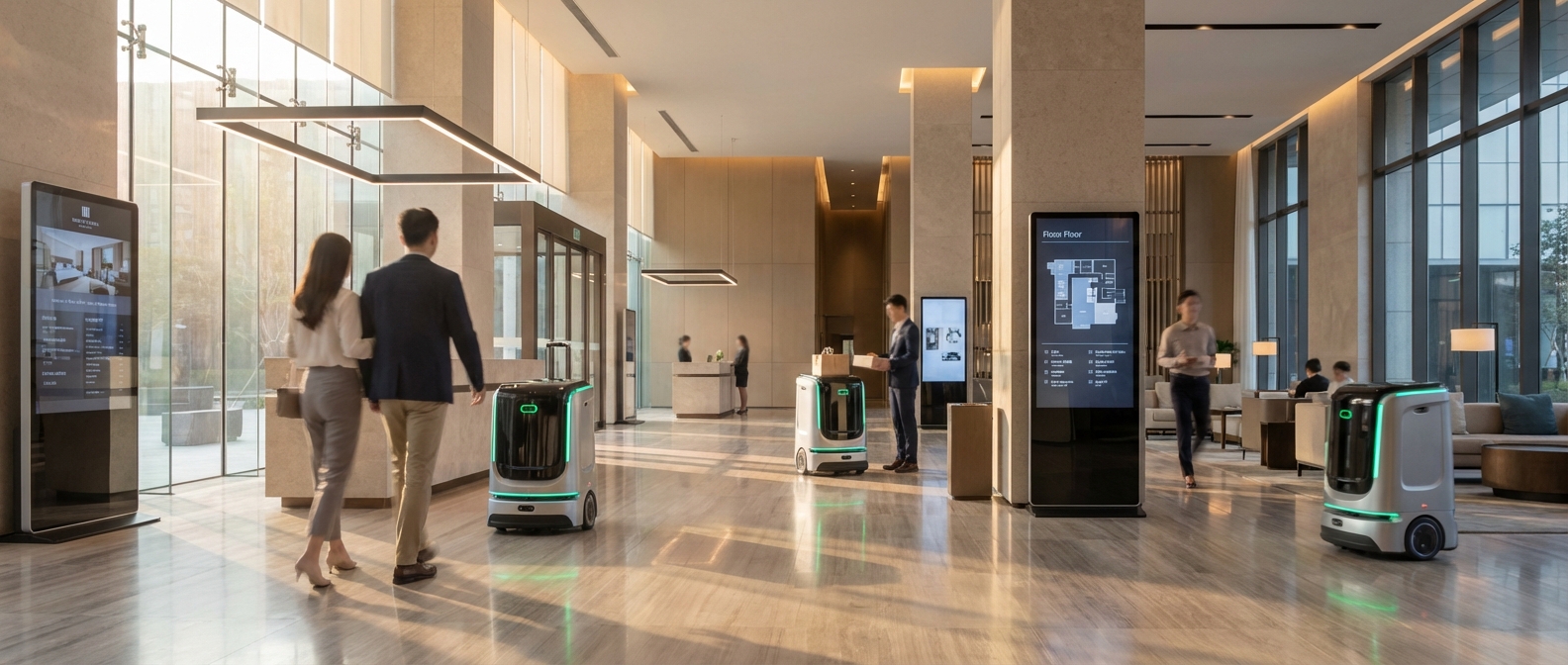
Why Robotics Matters Here
Staffing Shortages
With high turnover rates in hospitality, robots fill the gap by handling repetitive tasks like room delivery and vacuuming, allowing staff to focus on guest interaction.
24/7 Service Continuity
Guests expect service at all hours. Autonomous delivery robots provide room service and amenities overnight without the need for a full night-shift crew.
Hyper-Hygiene Standards
Post-pandemic travelers prioritize cleanliness. Cleaning robots ensure measurable, consistent sanitation in lobbies and hallways that manual cleaning can miss.
Operational Safety
Heavy lifting in back-of-house and constant floor scrubbing leads to staff injuries. Robotics take on the physical strain, reducing workers' comp claims.
Data-Driven Management
Smart robots provide analytics on cleaning times, delivery peaks, and traffic flow, helping managers optimize hotel operations based on real data.
Novel Guest Experience
Beyond utility, service robots act as a marketing differentiator. Guests enjoy the novelty of robot butlers, often sharing the experience on social media.
Applications in Hospitality & Hotels
Food & Beverage Service
Learn how food & beverage service transforms hospitality & hotels, from bussing tables to autonomous room service delivery.
Explore Application →Floor Cleaning
Learn how floor cleaning transforms hospitality & hotels by automating vacuuming and scrubbing in lobbies and corridors.
Explore Application →Last-Mile Delivery
Learn how last-mile delivery transforms hospitality & hotels, enabling secure transport of luggage and amenities to guest rooms.
Explore Application →How to Deploy
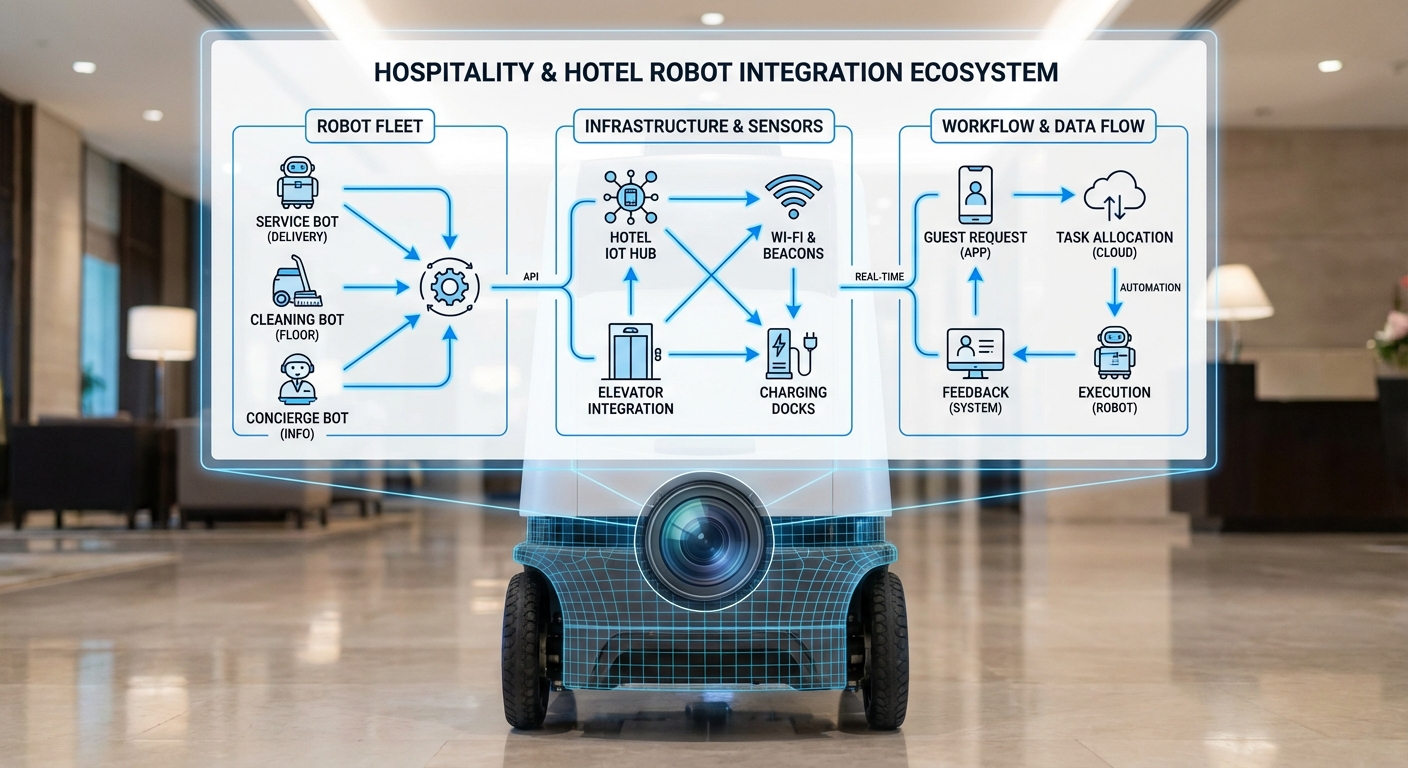
1. Site Assessment & Mapping: The first step involves a technical survey of your property. We map the "robot highways"—the lobbies, hallways, and elevators—to ensure seamless navigation. This phase identifies Wi-Fi dead zones and creates virtual boundaries around restricted areas like stairwells or pool decks.
2. Systems Integration: For multi-story hotels, elevator integration is critical. We install IoT modules that allow robots to wirelessly call elevators and select floors. Simultaneously, we integrate with your Property Management System (PMS) so front-desk staff can dispatch a robot to "Room 304" directly from their terminal.
3. Staff Training & "Cobot" Culture: Successful deployment isn't just technical; it's cultural. We train your staff to view robots as assistants ("cobots") that handle the dull, dirty, and dangerous work. Housekeeping learns to manage cleaning bot schedules, while concierge staff learn to load and dispatch delivery units.
4. Guest Onboarding: Finally, we ensure the guest interface is intuitive. When a robot arrives at a door, simple voice prompts and touchscreen instructions guide the guest to retrieve their items, ensuring a delightful rather than confusing experience.
Success Stories
Automating 24-Hour Room Service
Challenge: A 500-room resort struggled to staff overnight room service, leading to long wait times and cold food.
Solution: Deployed 3 autonomous delivery robots integrated with the kitchen POS and service elevators.
Large-Scale Floor Maintenance
Challenge: Managing the cleanliness of 200,000 sq ft of carpeted hallways and lobby space was physically exhausting for staff.
Solution: Implemented a fleet of industrial vacuum robotics running on pre-programmed night routes.
Banquet & Event Bussing
Challenge: Slow table turnover during large conferences caused delays in event schedules.
Solution: Utilized heavy-load bussing robots to carry dirty dishes back to the dish pit, keeping waiters on the floor.
Touchless Amenity Delivery
Challenge: Guests requested high privacy and minimal human contact for amenity delivery (towels, toiletries).
Solution: Deployed a sleek, compact delivery bot specifically for small items.
Industry-Specific Questions
How do robots navigate multi-story hotels?
Robots utilize IoT modules to interface wirelessly with elevator controls. They can "call" the elevator, select the specific floor via Wi-Fi or 4G/5G, and enter/exit safely. We configure the system so robots generally wait if an elevator is full of guests to maintain courtesy.
Will these robots replace my hospitality staff?
No. In hospitality, the "human touch" is irreplaceable. Robots are designed to handle repetitive, low-value tasks (like running a toothbrush to Room 402 or vacuuming a long corridor), freeing up your human staff to focus on concierge services, guest relations, and complex problem-solving.
Are the robots safe around children and guests?
Yes. They are equipped with Lidar, 3D cameras, and ultrasonic sensors to detect obstacles instantly. They are programmed to stop or navigate around people, pets, and luggage. They move at safe, walking speeds and have emergency stop buttons.
How do we prevent theft or vandalism of the robots?
Delivery robots feature locking compartments that only open via a PIN code provided to the guest. Additionally, all robots have built-in cameras and GPS tracking. Tampering usually triggers an audible alarm and a notification to the front desk.
What is the battery life and charging time?
Most hospitality robots run for 8-10 hours on a single charge. They are autonomous, meaning they will automatically return to their docking station when the battery is low. Charging typically takes 3-4 hours.
Do the robots work on carpet?
Yes. Delivery and cleaning robots are designed with suspension systems capable of traversing standard hotel carpeting, tile, and marble, as well as transitioning over thresholds between different flooring types.
Does the robot integrate with our PMS (Property Management System)?
We offer API integrations with major PMS providers (like Oracle Opera, Amadeus, etc.). This allows the robot to verify guest details and log delivery completions directly into your existing workflow.
Are the robots noisy?
Delivery robots are virtually silent. Cleaning robots produce noise similar to a standard vacuum cleaner but can be scheduled to clean lobbies and public areas during off-peak hours (e.g., 2 AM - 5 AM) to minimize disturbance.
What happens if the Wi-Fi goes down?
Robots have stored maps locally. While they may lose the ability to receive new commands or call elevators without a connection (unless 4G/LTE backup is enabled), they can safely navigate back to their charging station using their internal sensors.
Can we brand the robots?
Absolutely. Many hotels wrap the robots in brand colors, give them names, and even dress them in ties or hats. This customization turns the robot into a photo opportunity and a mascot for the hotel.
How long does mapping take?
For a standard hotel layout, mapping typically takes 1-2 days. This involves manually driving the robot through the space once to scan the environment. Adjustments and "no-go zones" are then configured in the software.
What is the typical ROI period?
Depending on labor costs in your region and the specific application, most hotels see a Return on Investment within 12 to 18 months, driven by labor savings and increased operational efficiency.