Floor Cleaning
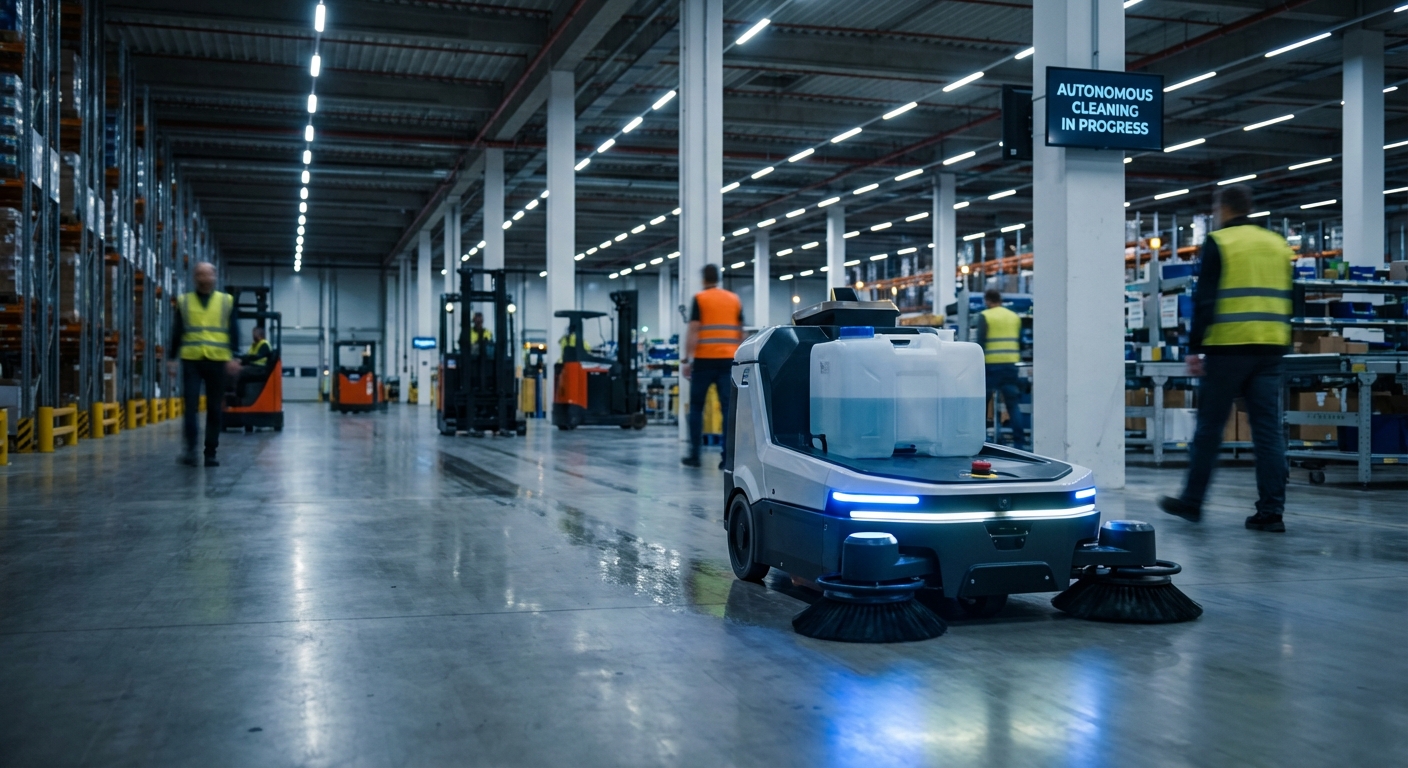
Revolutionize facility management with autonomous precision. Our floor cleaning application delivers consistent hygiene standards, reduces operational costs, and allows human staff to focus on high-value tasks using advanced SLAM navigation.
Why Automate Floor Cleaning?
Cost Reduction
Significantly lower labor costs by automating repetitive cleaning tasks, achieving ROI in as little as 12 months.
Consistent Quality
Robots follow precise mapping algorithms, ensuring 99.9% floor coverage without missing spots or cutting corners.
24/7 Availability
Schedule cleaning cycles during off-hours or night shifts to minimize disruption to daily operations.
Water Conservation
Advanced fluid management systems reduce water and chemical usage by up to 70% compared to manual mopping.
Real-time Analytics
Monitor fleet status, coverage maps, and consumables levels remotely via our cloud dashboard.
Enhanced Safety
ISO-compliant obstacle avoidance protects personnel and assets, reducing slip-and-fall liability.
Intelligent Navigation Workflow
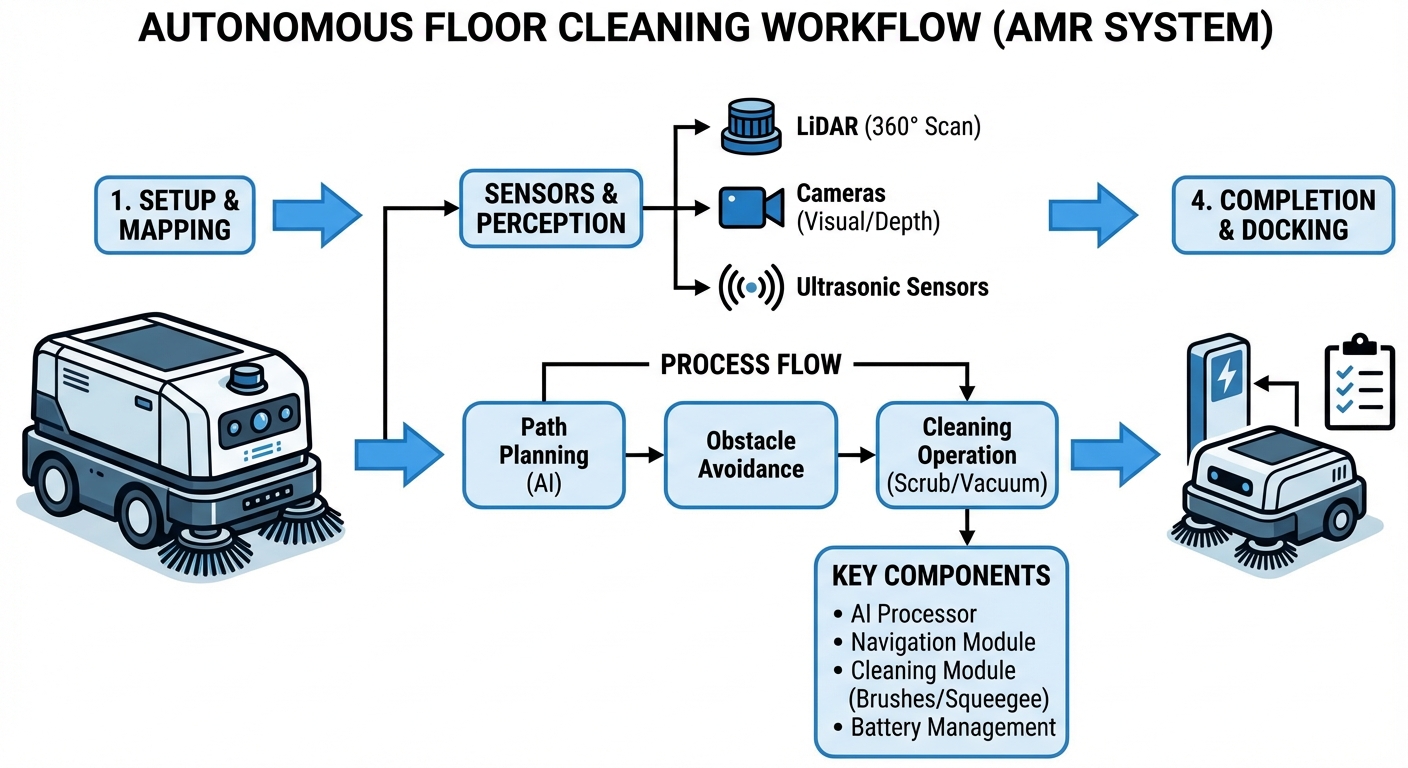
Our Floor Cleaning application utilizes a sophisticated multi-layer sensor stack. Upon initialization, the robot performs a SLAM (Simultaneous Localization and Mapping) pass to generate a high-fidelity digital twin of your facility.
Once mapped, operators define "No-Go Zones" and cleaning schedules. During operation, Lidar and 3D depth cameras work in unison to detect dynamic obstacles—such as people or forklifts—re-routing the robot instantly to ensure safety and continuity.
When water levels are low or the battery requires charging, the robot autonomously returns to its docking station, refills/recharges, and resumes cleaning exactly where it left off.
Where It's Used
Warehousing & Logistics
Handling massive square footage with concrete flooring.
- Dust control to protect inventory
- Operations during night shifts
- Narrow aisle navigation
Retail & Shopping Malls
High-traffic environments requiring pristine aesthetics.
- Glass-like finishes on tile/terrazzo
- Immediate spill response
- Safe operation around shoppers
Healthcare Facilities
Critical hygiene standards and quiet operation.
- Disinfection capabilities
- Low-decibel cleaning modes
- Cross-contamination prevention
Airports & Transport Hubs
Large open spaces with dynamic crowds.
- Rapid coverage of terminals
- Security-compliant navigation
- Asset tracking and reporting
What You Need
| Category | Requirements |
|---|---|
| Sensors |
2D/3D Lidar for mapping (20m+ range) IMU (Inertial Measurement Unit) Ultrasonic or ToF sensors for glass detection Cliff sensors for drop-off protection |
| Hardware Capability |
Differential drive or Ackermann steering Integrated clean/dirty water tanks Brush motor control interface Automated docking interface |
| Compute |
Industrial PC or Jetson Orin/Xavier Minimum 8GB RAM ROS 2 Humble/Iron supported |
| Integration |
Wi-Fi 6 for fleet management connectivity API access for Building Management Systems (BMS) Elevator control module (optional) |
Frequently Asked Questions
Is the robot safe to operate around humans? +
Yes. The robots are equipped with multi-tiered safety systems including Lidar, depth cameras, and physical bumpers. They are designed to detect obstacles and stop immediately or navigate around them, complying with ISO 13849 safety standards.
What types of flooring are supported? +
Our application supports a wide variety of hard floor surfaces, including concrete, epoxy, tile, terrazzo, marble, and vinyl. It is not designed for carpeted areas or extremely rough outdoor terrain.
How does the robot handle water refilling? +
With a compatible workstation, the robot can autonomously drain dirty water and refill with clean water and solution. Without the workstation, a human operator can manually swap tanks in under 2 minutes.
Does it require an internet connection? +
The robot performs all navigation and safety processing locally on the edge. An internet connection is only required for remote monitoring, software updates, and fleet management analytics.
What is the battery life? +
Depending on the model and cleaning intensity, run times typically range from 4 to 6 hours. The robot supports "opportunity charging," meaning it will top up its battery during breaks to extend daily uptime.
Can it clean multiple floors? +
Yes. The software supports multi-map storage. If integrated with elevator controls, the robot can navigate between floors autonomously. Otherwise, it can be manually moved and simply switched to the correct map.
Does it clean edges and corners? +
Yes. The robot features specific "Edge Cleaning" modes and is equipped with side brushes that sweep debris from corners into the main scrubbing path.
How difficult is the setup process? +
Setup is designed to be "Teach and Repeat." A user manually walks the robot through the environment once to build the map. Afterward, boundaries and zones are drawn on a tablet interface. Total setup time for a 10,000 sq ft facility is typically under 2 hours.
What maintenance is required? +
Daily maintenance involves emptying the dirty water tank and rinsing the squeegee. Weekly checks include cleaning sensors and inspecting brushes for wear. The system provides alerts when consumables need replacement.
What is the Return on Investment (ROI)? +
For facilities cleaning daily, ROI is typically achieved within 12 to 18 months through labor savings alone. This does not account for the indirect benefits of consistent hygiene and reduced chemical usage.
Ready to implement Floor Cleaning?
Discover the hardware platforms that power this application.
Explore Our Robots