Last-Mile Delivery
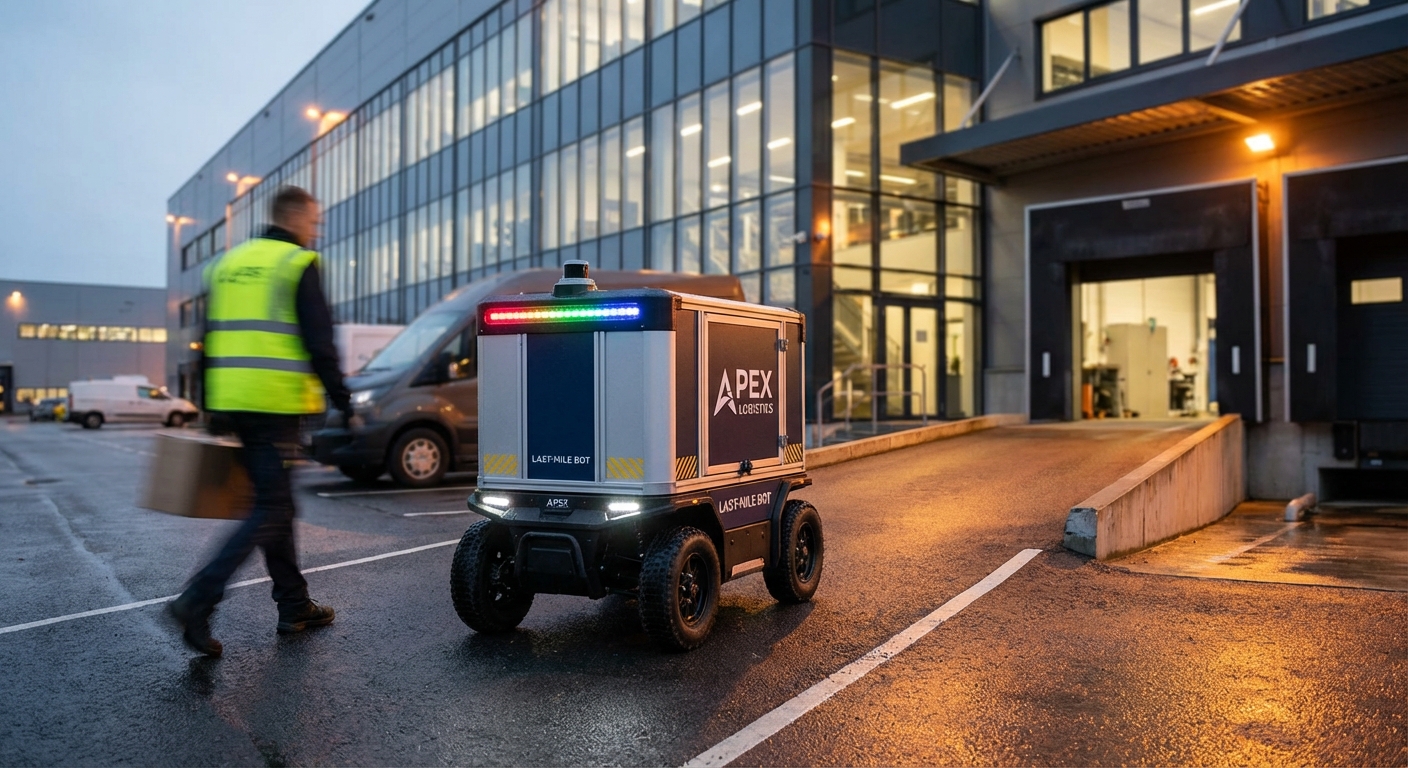
Revolutionize urban logistics with autonomous robots designed to bridge the final gap between distribution hubs and customer doorsteps. Reduce operational costs by up to 40% while ensuring contactless, on-demand delivery for retail, food, and parcel services.
Why Automate Last-Mile Delivery?
Reduced Operational Costs
Eliminate the high labor costs associated with human couriers for short-distance trips. Robots operate for a fraction of the hourly wage.
Contactless & Safe
Ensure hygiene and privacy with zero-contact handovers. Secure cargo compartments unlock only via customer mobile app verification.
24/7 Availability
Robots don't need sleep or shifts. Offer late-night food delivery or early morning parcel drop-offs without scheduling constraints.
Zero Emissions
Reduce your carbon footprint. Our electric delivery robots provide an eco-friendly alternative to gas-powered delivery vans and scooters.
Precision Tracking
Real-time GPS and sensor fusion allow customers to track their delivery to the exact meter, eliminating the "delivery window" frustration.
Scalable Fleet
Easily deploy additional units during peak hours or holidays. Our centralized fleet management software makes scaling effortless.
Autonomous Navigation & Workflow
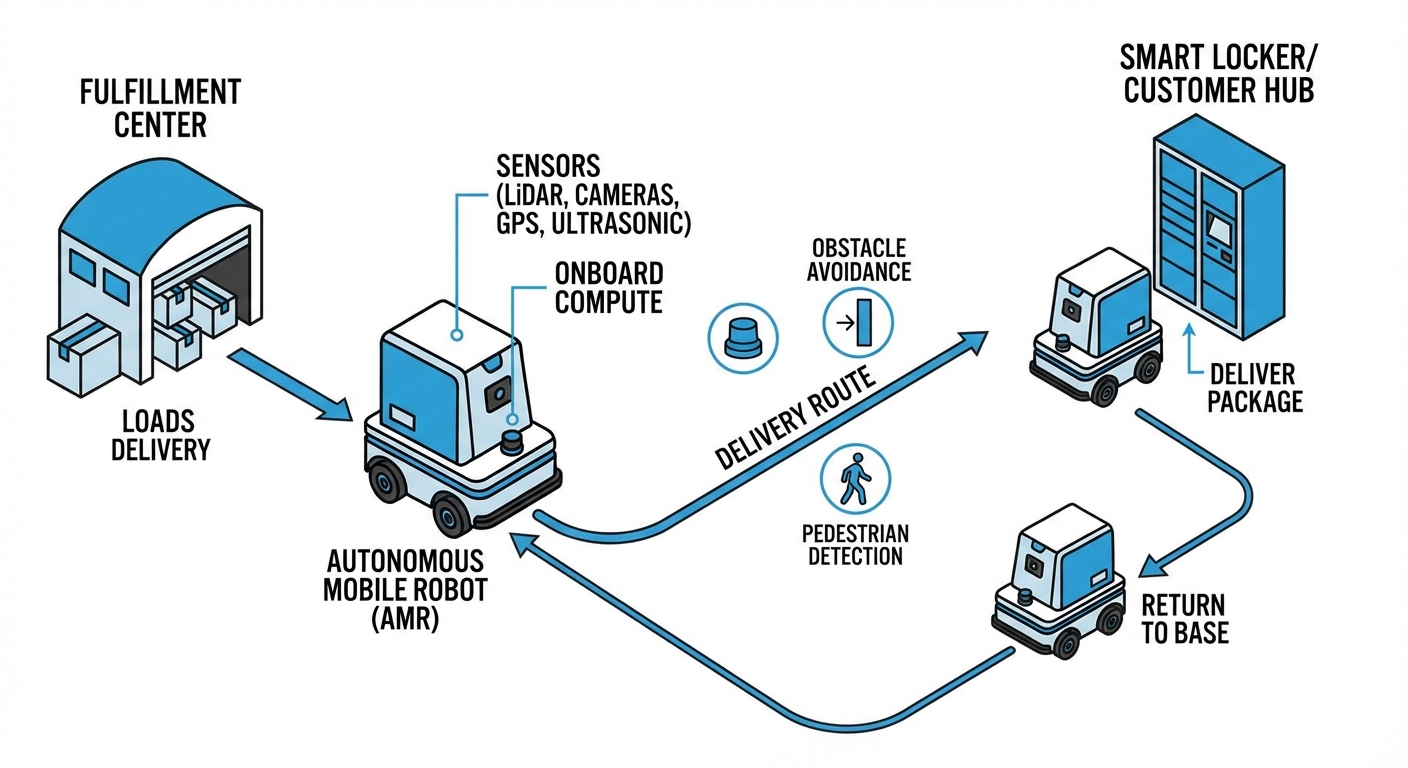
Our robots utilize advanced SLAM (Simultaneous Localization and Mapping) to navigate complex urban environments. By fusing data from LiDAR, depth cameras, and RTK-GPS, the robot identifies traversable paths on sidewalks while avoiding pedestrians, pets, and street furniture in real-time.
The Process: Orders are dispatched to the fleet management system, which assigns the nearest available robot. The robot travels to the vendor, accepts the package into its secure, locking cargo bay, and autonomously routes to the customer.
Upon arrival, the customer receives a notification with a unique unlock code or app-link. Once the cargo is retrieved, the robot automatically returns to its base or proceeds to the next pickup.
Where It's Used
Food & Beverage
Ideal for restaurant-to-customer deliveries within a 3-mile radius. Keeps food hot in insulated compartments and reduces the cost of delivery significantly compared to third-party apps.
Local Retail & Grocery
Automate neighborhood grocery runs and pharmacy deliveries. The rugged chassis handles heavy loads, making it perfect for delivering weekly staples or urgent medications.
Corporate & University Campuses
Streamline internal logistics by moving mail, IT equipment, and supplies between buildings. Enhance the campus experience with student-facing food delivery robots.
Hospitals & Healthcare
Secure transport of lab samples, sterile supplies, and linens between wards. Robots can navigate elevators and secure doors, reducing staff workload.
What You Need
| Component | Requirement |
|---|---|
| Sensors | 3D LiDAR (360° view), Stereo Depth Cameras, Ultrasonic Sensors |
| Connectivity | 4G/5G Cellular Module (Low Latency), Wi-Fi 6 for base station sync |
| Compute | Edge AI Processor (e.g., NVIDIA Jetson Orin) for real-time inference |
| Software Stack | ROS 2 (Robot Operating System), Autoware or Custom Path Planning |
| Infrastructure | Charging Station (Docking), Remote Operator Dashboard |
| Payload | Secure, weather-proof cargo bay (Min 40L capacity) |
Frequently Asked Questions
How do robots handle curbs and uneven terrain?
Our robots feature a 6-wheel independent suspension system capable of climbing curbs up to 15cm high. The chassis is designed to stabilize the payload, ensuring contents—including liquids—remain undisturbed during traversal.
What happens if a robot encounters a blocked sidewalk?
The robot uses local path planning to attempt to navigate around the obstacle. If the path is completely blocked, the robot halts safely and alerts a remote human teleoperator who can view the camera feed and manually guide the robot around the obstruction.
Is the cargo secure against theft?
Yes. The cargo lid is mechanically locked and can only be opened via the recipient's mobile app. Additionally, the robot has multiple cameras recording 360-degree footage, GPS tracking, and an audible alarm system that triggers if the robot is tampered with or lifted.
What is the battery life and range?
Depending on the model and payload weight, robots typically operate for 8-12 hours on a single charge with a range of approximately 20-30 miles. They are capable of autonomous docking to recharge between deliveries.
Can they operate in rain or snow?
Our robots are IP65 rated, allowing operation in light to moderate rain and light snow. However, deep snow or ice may limit traction. In extreme weather alerts, the fleet is typically recalled to safety.
How fast do the robots travel?
For safety on pedestrian sidewalks, robots are speed-capped, typically at 4 mph (similar to a brisk walking pace). They may travel faster in designated non-pedestrian zones if local regulations permit.
Do I need to map my delivery area first?
Yes. An initial mapping run is required to create a high-definition semantic map of the operating zone. This helps the robot understand sidewalk boundaries, crosswalks, and permanent obstacles.
How do robots cross streets?
Robots use computer vision to detect traffic lights and crosswalk signals. They only cross at designated intersections when the signal allows and after verifying no oncoming traffic is present.
What is the maximum payload capacity?
Standard last-mile robots can carry between 20 to 30 lbs (approx 3-4 grocery bags). Heavy-duty industrial variants can handle payloads up to 100 lbs.
How are robots managed?
A centralized Fleet Management System (FMS) tracks all robots, battery levels, and active orders. One human supervisor can typically monitor a fleet of 15-20 autonomous robots simultaneously.