Robotics in Retail & E-commerce
The retail landscape is undergoing a seismic shift driven by the demand for instant gratification and omnichannel experiences. From automated micro-fulfillment centers to autonomous last-mile delivery, robotics is the key to scaling operations, ensuring inventory accuracy, and overcoming labor shortages.
Why Robotics Matters Here
Challenge: Labor Shortages
Retailers struggle to find staff for repetitive tasks like stocking shelves and warehouse picking during peak seasons.
Robots handle dull, dirty, and dangerous tasks 24/7, allowing human staff to focus on customer service.
Challenge: Inventory Accuracy
Manual stocktaking is slow and error-prone, leading to "out of stock" scenarios and lost revenue.
Computer vision robots scan shelves continuously, providing 99.9% inventory accuracy in real-time.
Challenge: Fulfillment Speed
Customers expect same-day or next-day delivery, pressuring traditional warehouse operations.
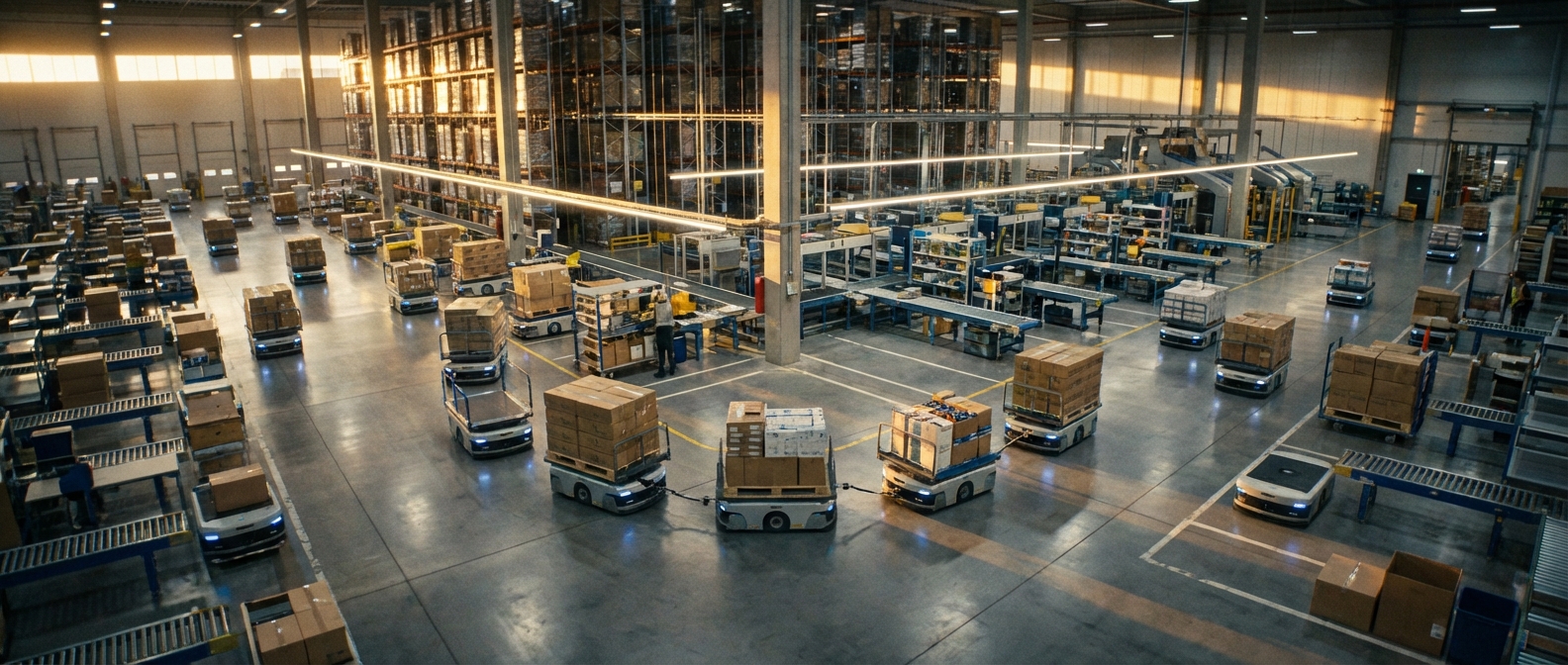
AMRs (Autonomous Mobile Robots) accelerate picking processes by bringing goods to person, tripling throughput.
Challenge: Last-Mile Costs
The final leg of delivery is the most expensive, often accounting for 53% of total shipping costs.
Sidewalk robots and drones reduce delivery costs significantly while offering contactless options.
Challenge: Seasonal Volatility
E-commerce demands spike unpredictably (e.g., Black Friday), straining static infrastructure.
Robotics as a Service (RaaS) allows retailers to scale their fleet up or down instantly based on demand.
Challenge: Omnichannel Complexity
Managing buy-online-pickup-in-store (BOPIS) requires precise coordination between backroom and storefront.
Automated storage systems streamline click-and-collect orders, retrieving items in seconds.
Applications in Retail & E-commerce
Retail Shelf Scanning
Learn how retail shelf scanning transforms retail & e-commerce through automated planogram compliance and price verification.
Explore Application →Inventory Management
Learn how inventory management & stocktaking transforms retail & e-commerce by synchronizing physical stock with digital ERPs.
Explore Application →Last-Mile Delivery
Learn how last-mile delivery transforms retail & e-commerce by enabling autonomous, contactless delivery in urban environments.
Explore Application →How to Deploy Robotics in Retail
1. Operational Assessment: Begin by analyzing your highest-friction points. Is it the time spent walking in the warehouse, or the inaccuracy of shelf tags in the storefront? Identifying the bottleneck determines whether you need AMRs for picking or vision-based cobots for scanning.
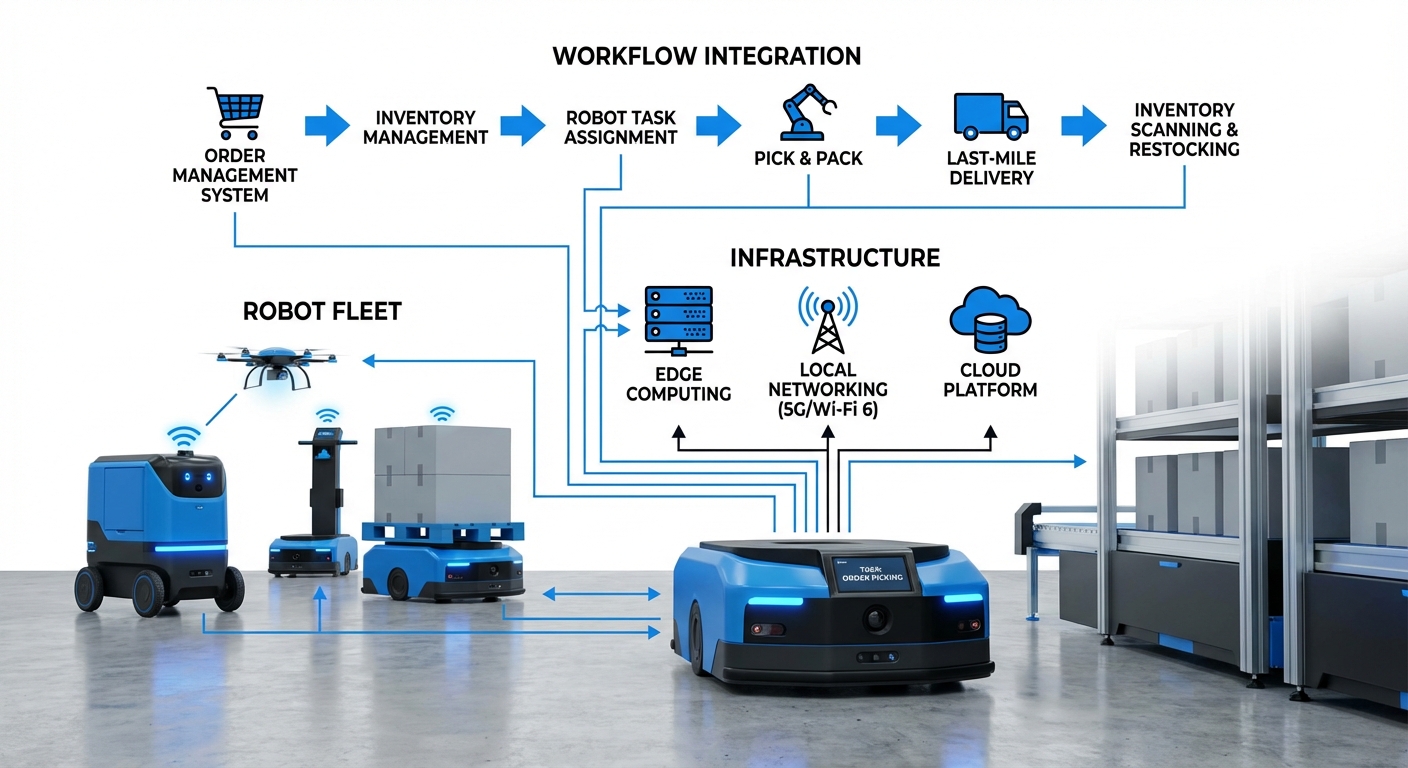
2. Integration & Mapping: Modern retail robots use SLAM (Simultaneous Localization and Mapping) to navigate complex aisles without physical guides. During this phase, the robots map your facility while your IT team integrates the robot fleet management software with your WMS (Warehouse Management System) or POS.
3. Pilot & Scaling: Start with a single location or a specific zone. Gather data on throughput improvements and error reduction. Once the ROI is proven—typically within 6 to 12 months—scale the fleet across multiple distribution centers or retail outlets using cloud-based deployment tools.
4. Change Management: Educate your workforce. Show staff how robots function as tools to eliminate heavy lifting and repetitive walking, rather than as replacements.
Success Stories
Automating Fresh Inventory
A national grocery chain struggled with perishables going to waste due to poor rotation and stock visibility.
Peak Season Scalability
A clothing retailer faced a 400% order surge during Black Friday, resulting in delayed shipments.
The Micro-Fulfillment Shift
Needed to utilize back-of-store space to fulfill online orders faster without disrupting in-store shoppers.
Contactless Campus Delivery
A university campus needed a way to deliver food and supplies to dorms securely.
Industry-Specific Questions
Are these robots safe to operate around customers in a store?
Yes. Front-of-store robots are equipped with LiDAR, 3D cameras, and ultrasonic sensors that allow them to detect people and obstacles instantly. They are programmed to yield to shoppers, stop immediately if an object is too close, and navigate crowds safely.
How long does it take to integrate robots with our WMS/ERP?
Integration times vary, but modern API-first robotics platforms can integrate with standard WMS (like SAP, Oracle, or Manhattan) in as little as 4-8 weeks. The physical mapping of the space takes only a few days.
Can robots handle fragile or irregularly shaped items?
Advancements in soft robotics and suction-based grippers allow picking arms to handle items ranging from lipstick tubes to poly-bagged clothing. However, extremely heavy or highly irregular items may still require human intervention.
What is the typical ROI timeframe for warehouse automation?
For Autonomous Mobile Robots (AMRs) that require no infrastructure changes (like bolted-down racks), ROI is typically achieved in 9 to 15 months due to labor savings and efficiency gains.
Do we need to change our store layout for shelf-scanning robots?
Generally, no. As long as aisles meet Americans with Disabilities Act (ADA) width standards, the robots can navigate them. They are designed to fit into existing environments, not require new ones.
How are theft and vandalism handled for delivery robots?
Delivery robots have locking cargo lids, GPS tracking, multiple cameras, and loud alarms. If tampered with, they can alert operators and record video evidence. Incidents of theft are statistically very low.
Does the robot fleet require a strong Wi-Fi connection?
Robots need a connection to receive orders and transmit data, but most are capable of operating autonomously if the signal drops temporarily. Many enterprise deployments utilize private 5G or robust industrial mesh Wi-Fi networks.
Can we rent robots for peak seasons only?
Yes, the Robotics-as-a-Service (RaaS) model is very popular in retail. It allows businesses to lease additional units for Q4 (Holiday season) and return them afterward, treating robotics as an OpEx rather than CapEx.
What maintenance do these robots require?
Routine maintenance includes sensor cleaning (wiping lenses) and checking wheels/tires. Batteries typically last a full shift and charge automatically. Most RaaS contracts include preventative maintenance and 24/7 support.
How accurate is the shelf-scanning data?
Computer vision algorithms combined with precise navigation allow robots to read barcodes, prices, and stock levels with over 99% accuracy, significantly outperforming manual spot checks.
Ready to transform Retail & E-commerce?
Join the leading retailers optimizing their supply chains with intelligent automation.
Explore Our Robots