Precision Spraying
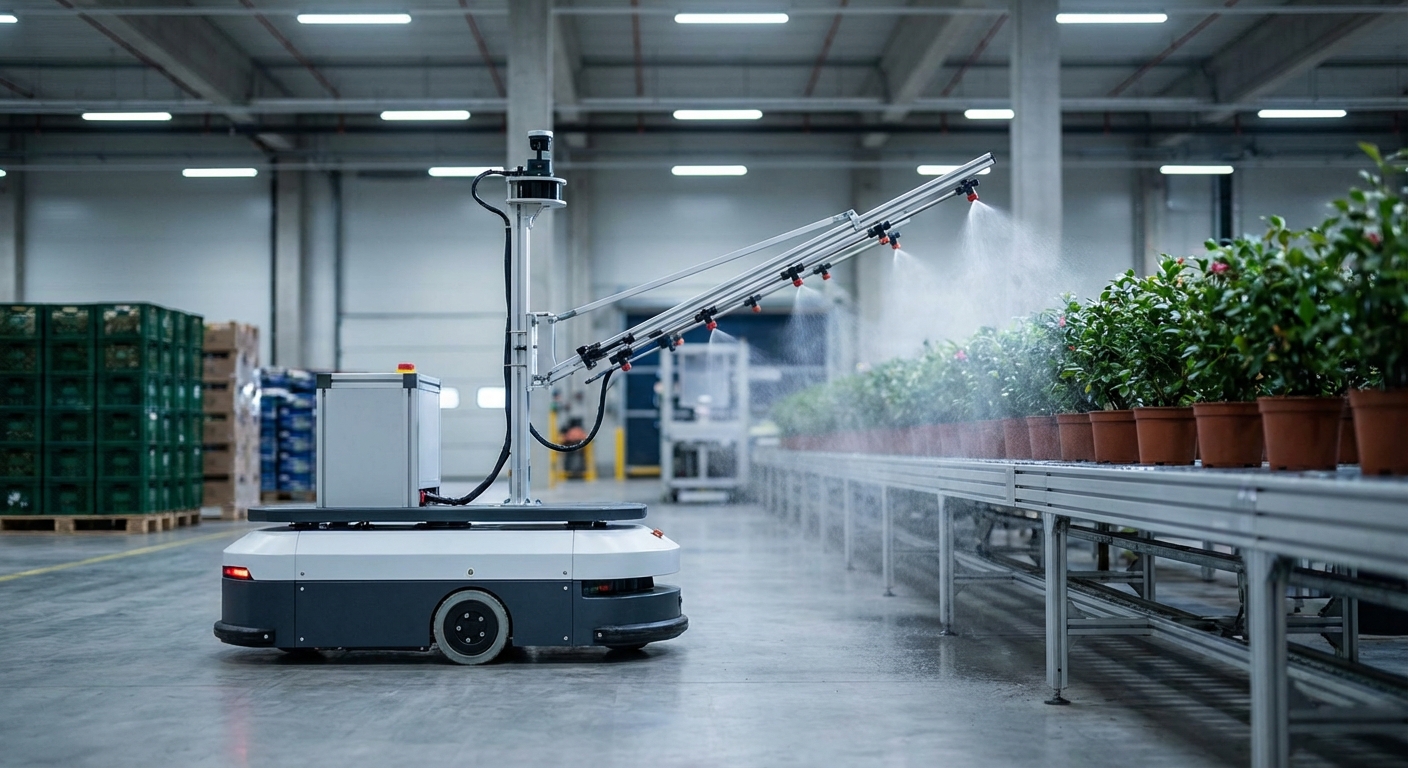
Revolutionize surface treatment and agriculture with sub-millimeter accuracy. Our robotic precision spraying solutions reduce material waste by up to 30% while ensuring uniform coverage on complex 3D geometries, eliminating the inconsistencies of manual application.
Why Automate Precision Spraying?
Drastic Material Savings
Precise flow control and path planning reduce overspray and wasted coating material, significantly lowering operational costs.
Consistent Quality
Achieve perfectly uniform film thickness every time. Robots eliminate human factors like fatigue or inconsistent hand speed.
Worker Safety
Remove operators from hazardous environments involving volatile organic compounds (VOCs), fumes, and toxic chemicals.
Complex Geometry
6-axis arms can manipulate spray nozzles at optimal angles to reach deep recesses and curved surfaces unattainable by gantry systems.
High Throughput
Operate 24/7 with consistent cycle times. Robots can move faster and spray more accurately than manual labor, increasing total output.
Flexible Deployment
Switch between different fluid types, spray patterns, or product models rapidly through software reconfiguration rather than mechanical changes.
Seamless Integration & Control
The system integrates high-resolution 3D vision with a 6-axis robotic arm. Before spraying begins, the vision system scans the target object, generating a point cloud to account for any variations in positioning or shape.
Proprietary algorithms calculate the optimal toolpath, adjusting the nozzle speed, distance, and spray pressure in real-time. This ensures that the edges receive the same coating thickness as the flat surfaces, a technique known as "variable rate application."
The entire workflow is monitored via a central HMI, providing live telemetry on fluid consumption, environmental conditions (humidity/temperature), and cycle completion status.

Where It's Used
Body Painting & Sealing
Applying primer, base coats, and clear coats to vehicle bodies, as well as applying underbody sealants and seam sealing with millimeter precision.
Spot Weed Treatment
Using mobile robots equipped with computer vision to identify weeds among crops and spray herbicides only on the weeds, reducing chemical use by up to 90%.
Adhesives & Bonding
Application of structural adhesives and thermal pastes for electronics and aerospace components, ensuring strong bonds without overflow or gaps.
Wood Finishing
Staining and varnishing complex wooden furniture pieces. The robot maintains a consistent gun distance even on carved legs and chair backs.
What You Need
Frequently Asked Questions
How does the robot handle different fluid viscosities?
Our system supports interchangeable pumps (gear, piston, or diaphragm) and integrates with flow meters that adjust pressure dynamically. This allows the robot to handle everything from water-thin solvents to high-viscosity sealants.
Can the robot spray parts on a moving conveyor?
Yes. Using "Conveyor Tracking" technology, the robot synchronizes its movements with the speed of the line. An encoder on the conveyor feeds data to the robot controller, ensuring the spray pattern remains consistent even if the line speed fluctuates.
What safety certifications are required for painting robots?
If you are spraying flammable materials (solvent-based paints), the robot and its auxiliary equipment must be Explosion Proof (ATEX or Class 1, Div 1 rated). The arm is pressurized to prevent gas ingress.
How difficult is it to program new parts?
We utilize Offline Programming (OLP) software. You can import a CAD model of your part and generate spray paths automatically on a PC. This can be done while the robot is working on other tasks, minimizing downtime.
Does the system prevent nozzle clogging?
Yes, the robot is programmed with automated purging and cleaning cycles. It moves to a cleaning station at set intervals (or during color changes) to flush the lines and clean the nozzle tip.
What is the typical Return on Investment (ROI)?
Most customers see an ROI within 12 to 18 months. The savings come from a 20-30% reduction in paint usage, lower rework rates, and increased throughput compared to manual labor.
Can I retrofit my existing spray gun?
It is possible, but not always recommended. Manual guns are not designed for the rapid triggering and continuous duty cycle of a robot. Automatic guns designed for mounting are preferred for reliability.
How does the robot ensure uniform thickness on corners?
The software adjusts the TCP (Tool Center Point) speed and fluid flow rate as the robot rounds a corner. This prevents "paint build-up" on the inside of curves and "thinning" on the outside.
Is vision integration mandatory?
No. If your parts are fixtured precisely in the same spot every time, vision is not needed. Vision is only required if part positioning varies or if you are identifying different parts on a mixed line.
Can this be used for outdoor agricultural robots?
Yes. We offer ruggedized mobile manipulator configurations designed for outdoor terrain (IP65/IP67), utilizing GPS and LIDAR for navigation in crop fields.