Laboratory Sample Transport
Automate the secure and efficient movement of biological specimens between collection points and testing stations. Eliminate human error, reduce cross-contamination risks, and allow skilled technicians to focus on high-value analysis rather than logistics.
Why Automate Laboratory Sample Transport?
Chain of Custody
Digital tracking ensures every sample's location is recorded from pickup to delivery, providing an audit trail that meets rigorous compliance standards.
Contamination Control
Reduce human traffic in sensitive areas. Robots can be easily sterilized and do not carry external pathogens into sterile lab environments.
Increased Throughput
Robots work continuously without breaks, smoothing out peak demand periods and ensuring samples aren't sitting idle waiting for transport.
Staff Optimization
Lab technicians and nurses spend less time walking hallways and more time on patient care and sample analysis.
Secure Transport
Biometric or RFID locking compartments ensure that only authorized personnel can load or retrieve sensitive biological samples.
Cost Reduction
Significant ROI through reduced courier costs, lower breakage rates, and optimized labor allocation within the healthcare facility.
Seamless Integration into Workflow
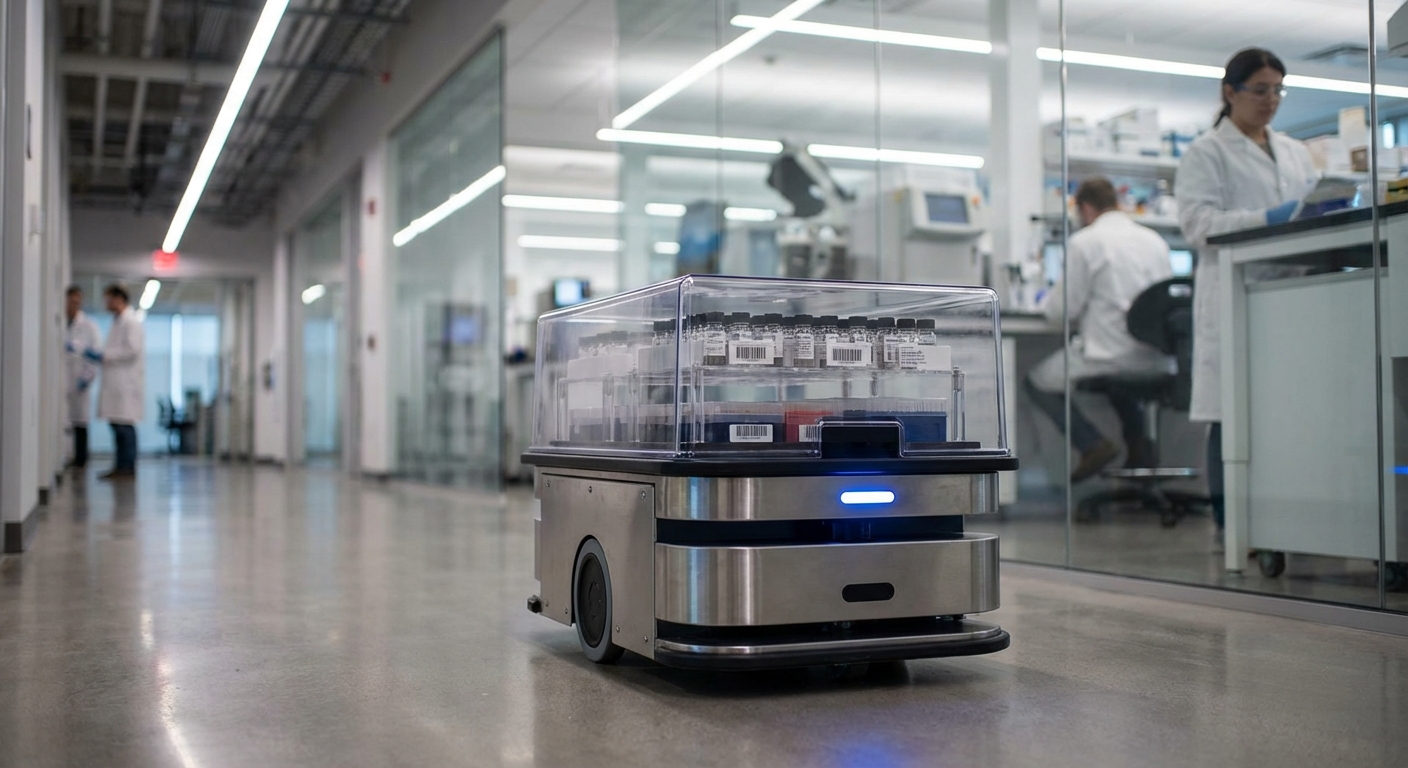
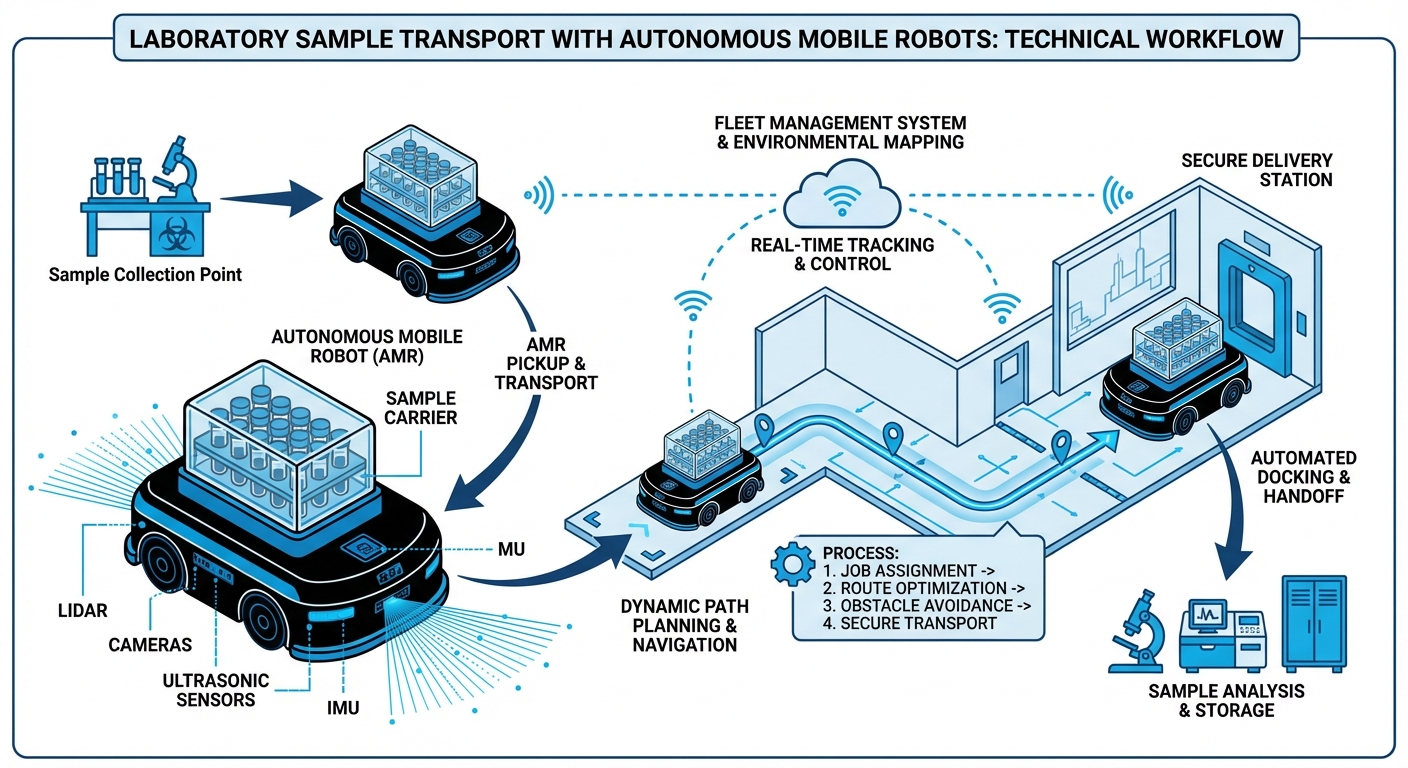
The robot autonomously navigates the facility using LiDAR and SLAM technology. When a sample is ready at a nursing station or collection point, staff place the vials into the secure carrier and request a pickup via a touchscreen or LIS integration.
The robot interfaces directly with facility infrastructure, opening automatic doors and communicating with elevator controls to travel between floors without human assistance.
Upon arrival at the central lab, the robot notifies the receiving technician. In fully automated setups, the robot can dock directly with a lab track system to offload samples for immediate processing.
Where It's Used
Clinical Hospital Networks
Connecting emergency departments, phlebotomy stations, and inpatient wards directly to the central pathology laboratory to speed up turnaround times for critical diagnoses.
Pharmaceutical R&D
Transporting high-throughput screening plates between incubators, readers, and storage units in large-scale drug discovery facilities.
Bio-Banking Facilities
Secure movement of cryo-preserved samples from long-term storage freezers to processing benches, maintaining temperature integrity logs.
Toxicology & Forensics
Ensuring an unbroken, digitally recorded chain of custody for legal samples, minimizing handling and potential tampering risks.
What You Need
Sensors & Perception
- 3D LiDAR for mapping and obstacle avoidance
- Depth cameras for low-object detection
- Ultrasonic sensors for glass wall detection
- RFID/Barcode reader for sample ID (Optional)
Robot Capabilities
- Smooth acceleration (to prevent hemolysis)
- Liquid-tight, locking cargo compartment
- Self-charging capability
- Payload capacity: 5kg - 20kg
Software Stack
- Fleet Management System
- LIS (Laboratory Information System) API Bridge
- User interface for nursing stations (Tablet/Web)
- Audit log database
Facility Infrastructure
- Reliable Wi-Fi coverage in transport corridors
- Automated doors with integration relays
- Elevator integration module (for multi-floor)
- Dedicated charging station space (1m x 1m)
Frequently Asked Questions
Can the robots use elevators?
Yes. The robots are equipped with wireless modules that communicate directly with elevator controllers to call cars and select floors without human intervention.
How secure are the samples during transport?
The cargo compartments are electronically locked. They can only be opened via an RFID badge swipe or PIN code by authorized staff at the destination.
What happens if there is a spill?
The transport containers are sealed and liquid-tight to contain any spills. The internal trays are removable and autoclavable for easy cleaning and sterilization.
Does the robot shake the samples?
No. The acceleration and deceleration curves are specifically tuned to be gentle to prevent hemolysis (damage to blood cells) or agitation of sensitive compounds.
Can it navigate through crowded hallways?
Yes. The LiDAR and depth cameras detect static and dynamic obstacles (like people) in real-time, allowing the robot to safely stop or navigate around them.
Does it integrate with Epic/Cerner/LIS?
Yes, we provide an API bridge that can update the status of samples in your Laboratory Information System (LIS) upon pickup and delivery.
What is the battery life?
The robots typically run for 8-10 hours on a single charge and support "opportunity charging," meaning they autonomously dock to charge whenever they are idle.
How many samples can it carry?
It depends on the configuration, but standard carriers hold up to 4 standard test tube racks (approx. 200 vials) or 10kg of mixed materials.
Is Wi-Fi required everywhere?
Wi-Fi is recommended for real-time tracking and calling elevators. However, the robot can navigate autonomously using its internal maps if Wi-Fi drops temporarily.
What is the typical ROI?
Most facilities see a return on investment within 12-18 months based on savings from courier contracts and reclaimed nursing/technician labor hours.
Can it carry STAT (urgent) samples?
Yes. A "Priority" mode can be selected, which routes the robot immediately to the lab, bypassing other stops and triggering visual indicators for right-of-way.
How is the robot cleaned?
The exterior is compatible with standard hospital-grade disinfectants. The robot has an IP rating that allows for wipe-downs, though it is not submersible.