Hospital Supply Delivery
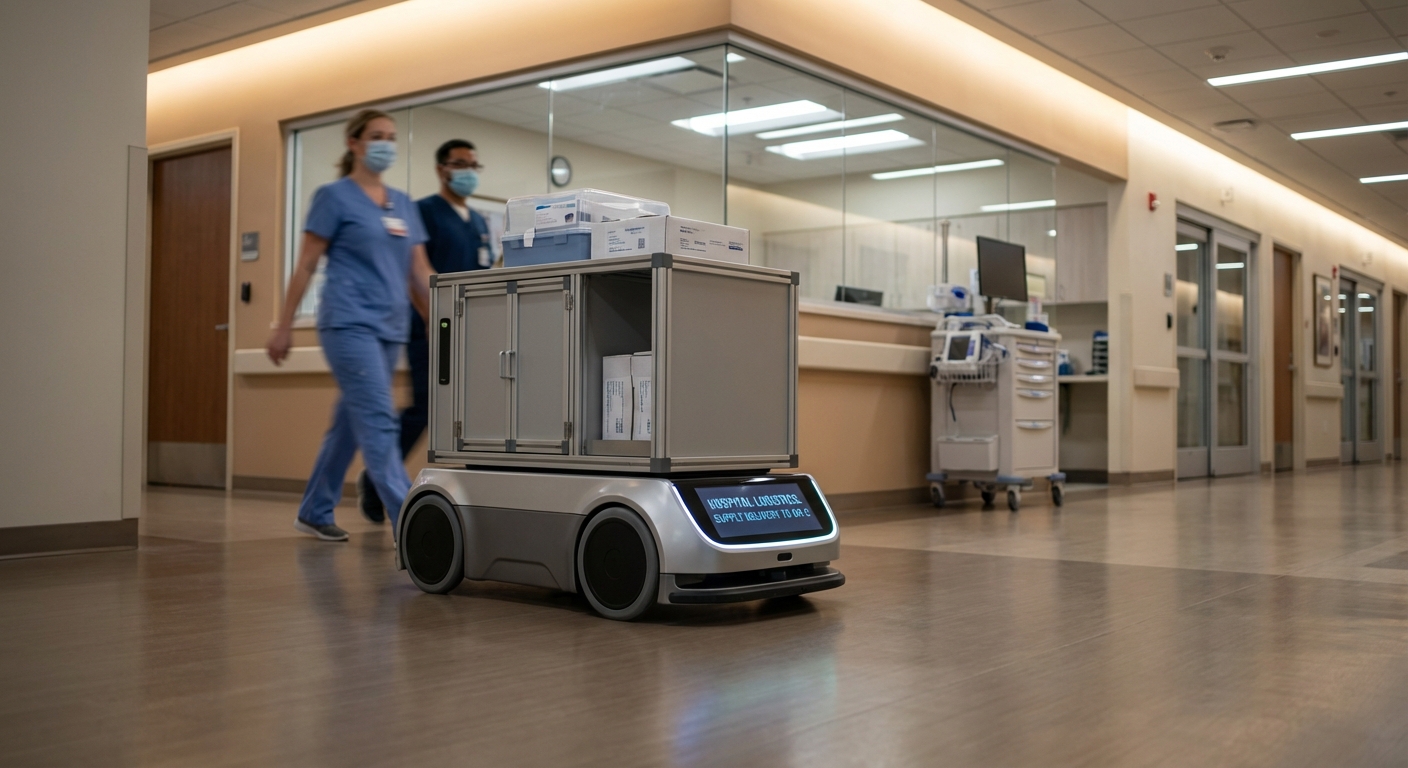
Revolutionize internal logistics with autonomous mobile robots designed to transport medications, lab samples, and linens securely. Free your clinical staff from non-value-added travel time, allowing them to focus entirely on patient care while ensuring 24/7 operational efficiency.
Why Automate Hospital Supply Delivery?
Staff Efficiency
Nurses walk miles per shift. Automating delivery reduces fatigue and keeps medical professionals at the bedside where they are needed most.
24/7 Availability
Robots don't take breaks or change shifts. Ensure critical supplies and lab results are moved instantly, day or night.
Chain of Custody
Secure, lockable compartments with biometric or badge access ensure that controlled substances are only accessed by authorized personnel.
Infection Control
Reduce human-to-human contact. Robots can be easily sanitized and do not act as vectors for cross-contamination between wards.
Cost Reduction
Significantly lower operational costs by automating routine transport tasks, delivering a measurable ROI typically within 12-18 months.
Intelligent Navigation
Advanced LiDAR and camera systems allow the robot to navigate dynamic hospital environments, avoiding gurneys, wheelchairs, and people.
Seamless Integration into Clinical Workflows
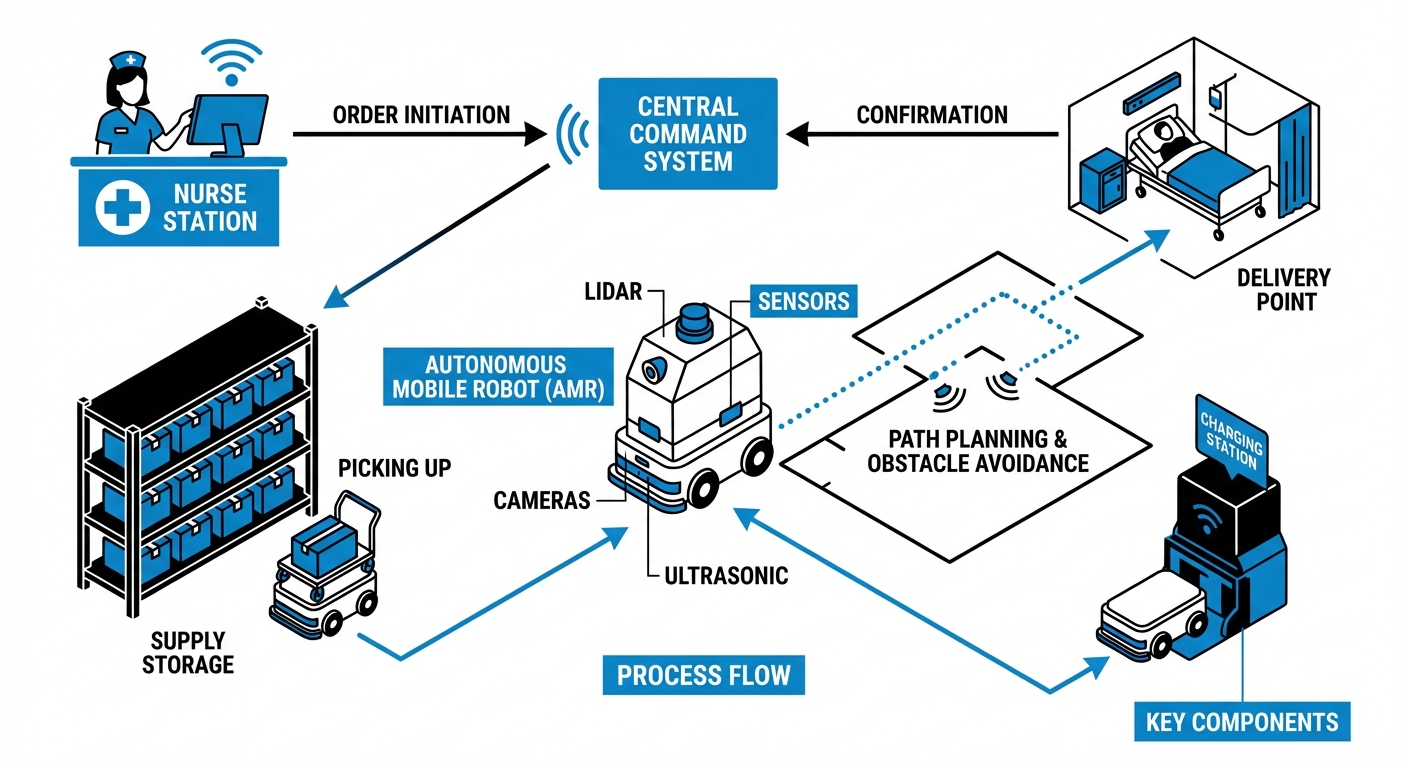
The Hospital Supply Delivery system utilizes a sophisticated Fleet Management System (FMS) that interfaces directly with your hospital's layout and infrastructure. Upon receiving a request via a tablet or Hospital Information System (HIS) integration, the robot autonomously plans the optimal path from the pharmacy or supply room to the nursing station.
Using multi-sensor fusion (LiDAR, RGB-D cameras, and ultrasonic sensors), the robot creates a dynamic map of the facility. It detects obstacles in real-time, waiting for paths to clear or re-routing instantly to avoid congestion in busy corridors.
Crucially, the robot is equipped with IoT modules to communicate with elevators and automated doors. It can call an elevator, select the correct floor, and exit autonomously, ensuring multi-story coverage without human assistance. Secure authentication at the destination ensures supplies reach the right hands.
Where It's Used
Pharmacy to Ward
Secure transport of scheduled medications and IV bags. The robot locks upon loading at the pharmacy and requires a nurse's badge swipe or pin code to unlock at the specific ward, maintaining a complete digital audit trail.
Laboratory Logistics
Rapid transport of blood samples, biopsies, and urine specimens from operating rooms or ERs to the central lab. Smooth acceleration profiles ensure samples are not agitated or damaged during transit.
Dietary & Food Service
On-demand delivery of patient meals or snacks outside of scheduled catering hours. Keeps food secure and hot/cold during transport, reducing the burden on catering staff for ad-hoc requests.
Sterile Processing
Transporting surgical instruments and sterile supplies from the Central Sterile Services Department (CSSD) to operating theaters. Segregated "Clean" and "Dirty" workflows prevent cross-contamination.
What You Need
| Category | Requirement Specification |
|---|---|
| Sensors | 2D/3D LiDAR (20m+ range), RGB-D Depth Cameras, Ultrasonic Sonar array, IMU. |
| Robot Capabilities | Max payload: 60kg+, Max speed: 1.5 m/s, Battery life: 8+ hours, Auto-docking charging. |
| Software Stack | ROS 2 based navigation, Centralized Fleet Manager (Server or Cloud), Web-based UI. |
| Integration | Wi-Fi 6 Mesh Network, REST API for Elevator/Door integration, HL7/FHIR interface for HIS. |
| Security | WPA3 Enterprise Wi-Fi security, RFID/NFC reader for cabinet access, Encrypted data logs. |
Frequently Asked Questions
How does the robot interact with elevators?
The robot communicates with the building's elevator controller via a wireless network or a dedicated API module. It can call the elevator, hold the door open, select the floor, and exit safely without human intervention.
Is it safe to operate around patients and visitors?
Yes. The robots are equipped with redundant safety systems including LiDAR and depth cameras. They detect static and dynamic obstacles instantly and will stop or reroute to maintain a safe distance from people at all times.
How secure are the medications inside the robot?
The cargo compartments are electronically locked. They can only be opened by authorized staff using an RFID badge, fingerprint scan, or a unique PIN code. All access events are logged for audit purposes.
What happens if there is a Wi-Fi dead zone?
The robot stores the facility map locally and can navigate autonomously without a constant Wi-Fi connection. It will simply buffer data and sync with the fleet manager once connectivity is restored.
How long does the battery last?
Typical runtime is 8-10 hours depending on the payload. The robots utilize "opportunity charging," automatically returning to their dock to top up the battery during idle periods, enabling essentially 24/7 operation.
Can the robot carry hazardous materials?
Yes, provided the materials are properly sealed according to hospital protocols. The smooth acceleration and deceleration protect sensitive payloads from spills or agitation.
How long does installation take?
Mapping a typical hospital wing can take 1-2 days. Full integration with elevators and doors usually takes 1-3 weeks depending on your facility's existing infrastructure readiness.
Is the robot easy to clean?
Yes, the robot's exterior is designed with non-porous materials compatible with standard hospital-grade disinfectants and UV-C cleaning protocols.
Does it require a dedicated operator?
No. The system is fully autonomous. Staff interact with it via simple touchscreens to send/receive items. A fleet manager dashboard is available for IT/Facilities to monitor status, but active driving is not required.
What is the ROI time frame?
Most hospitals see a Return on Investment within 12 to 18 months, driven by labor savings, reduced medication loss, and increased nursing time dedicated to patient care.
Ready to implement Hospital Supply Delivery?
Join leading healthcare institutions in the future of logistics.
Explore Our Robots