Research Robots Applications Industries Technology Contact
← Back to Applications
Robot Application

Assembly Line Transport

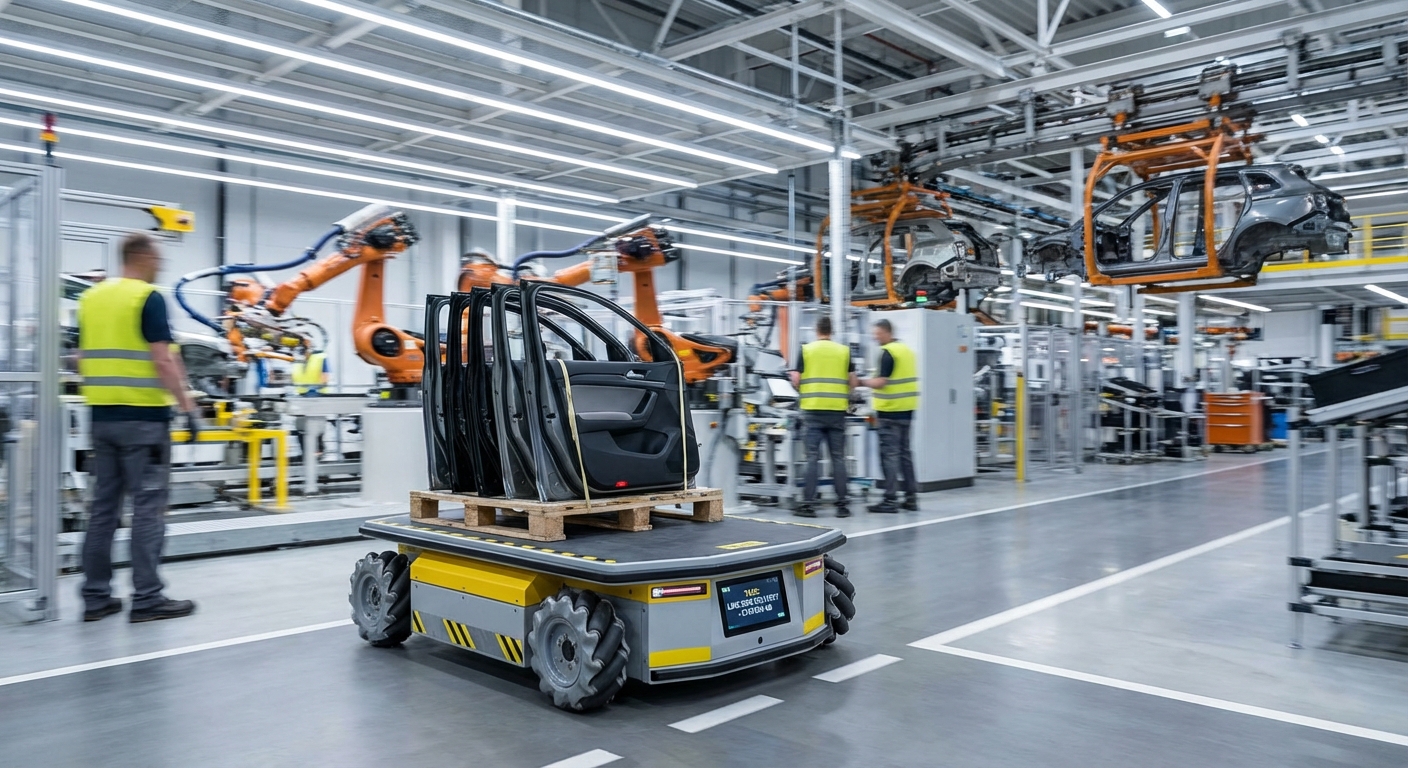
Revolutionize your manufacturing floor by automating the transfer of work-in-progress materials between stations. Enhance throughput, ensure just-in-time delivery, and free your human workforce for high-value tasks.
Assembly Line Transport

Why Automate Assembly Line Transport?

Maximized Throughput

Eliminate bottlenecks caused by manual transport. Robots deliver parts precisely when needed, keeping the line moving.

Enhanced Safety

Reduce forklift traffic and manual heavy lifting. AMRs utilize LiDAR and 3D cameras to navigate safely around workers.

24/7 Operations

Robots don't take breaks or change shifts. Enable lights-out manufacturing and continuous production cycles.

Scalable Flexibility

Easily reconfigure routes via software without magnetic tape or floor modifications as your production line evolves.

Accuracy & Traceability

Integrate with MES to track every movement. Ensure the right part arrives at the right station, reducing assembly errors.

Rapid ROI

Lower operational costs and increased output lead to a typical return on investment in less than 12 months.

Seamless Integration into Your Workflow

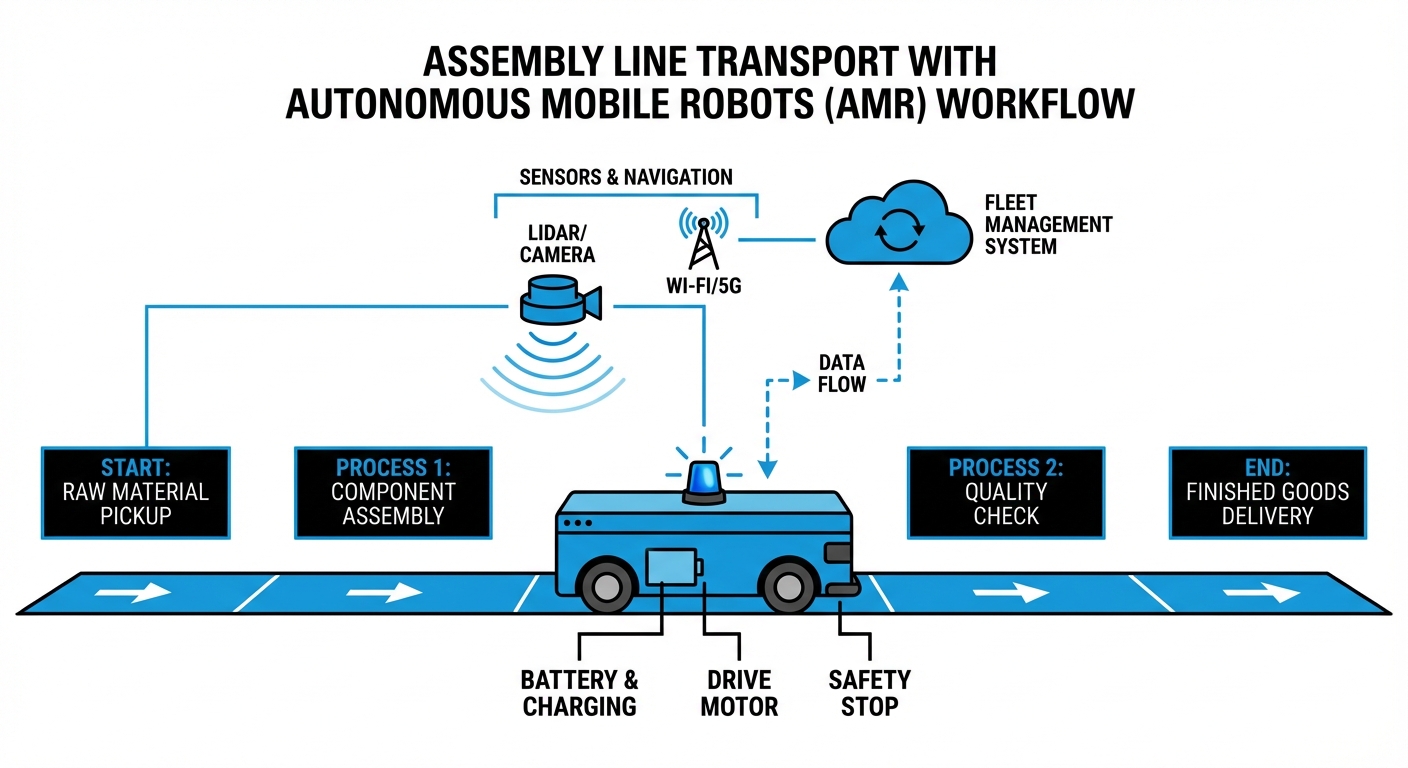
The system begins by mapping your facility using SLAM (Simultaneous Localization and Mapping) technology. Once mapped, the fleet manager software integrates directly with your Manufacturing Execution System (MES).

When an assembly station completes a task or runs low on materials, a signal is sent to the fleet manager. The software instantly assigns the nearest available robot to transport the finished sub-assembly to the next stage or deliver fresh components from inventory.

Robots navigate dynamically, avoiding obstacles and recalculating paths in real-time. Upon arrival, they can interface with automated conveyors for hands-free transfer or dock precisely for manual offloading.
Workflow Diagram

Where It's Used

Automotive

Engine & Chassis Assembly

Moving heavy engine blocks between machining centers and final assembly lines without fixed conveyors, allowing for flexible model switching.

Electronics

PCB & Component Transport

Delivering sensitive electronic components in ESD-safe racks from storage to SMT lines with vibration-controlled movement.

FMCG

End-of-Line Packaging

Transporting finished goods from filling stations to palletizing robots, relieving bottlenecks in high-speed bottling and packaging plants.

Pharmaceuticals

Clean Room Logistics

Automating material transfer in ISO-certified clean rooms to reduce human contamination risks and ensure strict audit trails.

What You Need

Hardware Infrastructure Autonomous Mobile Robots (AMR) with appropriate payload capacity (50kg - 1500kg) and top-module attachments (rollers, lifters, or racks).
Connectivity Industrial-grade Wi-Fi 6 or Private 5G network covering the entire transport area for real-time fleet communication.
Environment Flat, even flooring (concrete, resin, or tile). Minimum aisle width of 20% greater than robot width. Marked charging zones.
Software Stack Fleet Management Server, Navigation Client, and REST API integration with existing ERP/WMS/MES systems.
Safety Compliance Adherence to ISO 3691-4 safety standards for driverless industrial trucks and risk assessment certification.

Frequently Asked Questions

What is the difference between AGVs and your AMRs?

AGVs (Automated Guided Vehicles) require physical guides like magnetic tape or wires and stop if blocked. Our AMRs (Autonomous Mobile Robots) use LiDAR to map the facility and navigate freely, steering around obstacles and planning efficient paths dynamically without infrastructure changes.

Are these robots safe to work alongside humans?

Yes. Our robots are PL-d (Performance Level d) safety rated. They are equipped with 360-degree safety scanners and 3D cameras that detect humans and obstacles instantly, triggering a controlled stop or path deviation to ensure complete safety.

How long does the battery last?

Typical run time is 8-12 hours depending on payload. However, the system utilizes "opportunity charging," meaning the robot autonomously docks to charge during short idle periods, effectively allowing for 24/7 continuous operation.

Can the robots integrate with our existing MES/ERP?

Absolutely. Our Fleet Management software provides a robust REST API that connects with SAP, Oracle, Microsoft Dynamics, and custom MES platforms to receive orders automatically based on production triggers.

What is the maximum payload capacity?

We offer a range of chassis. Our light-duty models handle up to 100kg, medium-duty up to 500kg, and heavy-duty industrial models can transport up to 1500kg (pallet size).

Does installation require shutting down production?

Minimal to no shutdown is required. Mapping is done by manually driving the robot around the facility once. The virtual setup of zones and routes is done offline. Deployment is usually completed in days, not months.

Can the robots operate on ramps or uneven floors?

Most AMRs are designed for flat industrial floors. They can handle small thresholds (up to 15mm) and slight inclines (typically up to 5%). Significant ramps or rough terrain may require specialized chassis configurations.

What happens if the Wi-Fi goes down?

The robots have onboard computing. If Wi-Fi is lost, they will complete their current mission safely using stored maps and logic, then pause and wait for re-connection before accepting new tasks.

Do you support custom top-modules?

Yes. We provide standard modules (conveyors, lifts, hooks), but the top plate offers standard mounting holes and power/data interfaces for custom fixtures, robotic arms, or shelving units.

How is maintenance handled?

AMRs have few moving parts compared to forklifts. Routine maintenance involves cleaning sensors and checking tires/rollers every 3-6 months. We offer service packages for annual checkups and 24/7 remote support.

What is the ROI timeline?

While it varies by facility size, most customers achieve ROI within 9 to 14 months through labor savings, reduced material damage, and increased production efficiency.

Are there cleanroom compatible options?

Yes, we offer specific models designed for ISO Class 5 cleanrooms, featuring electrostatic discharge (ESD) protection and low-particle-generating tires.

Ready to implement Assembly Line Transport?

Explore Our Robots